Showing posts with label editorial cartoon. Show all posts

Thursday, December 17, 2015

Not enough black ink

Oh, how I wish this was a comic book!

Like the wonderful Watchmen, a grimly layered tale about costumed semi-superheroes who must adapt to a world that no longer tolerates them.

In it, Adrian Veidt, a former superhero who trumps Donald Trump in wealth and chutzpah, plots to unleash a horror so catastrophic that it fulfills his grand wish — the entire world abolishes divisions to unite and vanquish the horror.

I want Donald Trump to be that horror — a thing so devastating, so harmful, that people denounce their own ugliness and hate to turn against him and choose civil, reasonable leaders.

I want Trump to be what some pundits have proposed: So awful an impersonation of a human being that he'll drive followers away so that he can back out of the race, or drive voters to the Democratic ticket. I want him to be playing such a monumental prank on us all, if only to massage his giant ego, with the breezy gall of someone who has more money than God.

I want him to be a Democratic conspiracy, a trick deployed on the Republican Party, a massive inflated parody of itself, a hulking chicken having come home to roost.

But I'm afraid Donald Trump is real, and that he is in fact the runaway leader of the Republican ticket, and that he may win that party's nomination to the presidency.

And that makes me angry.

This cartoon, this little exercise with typing paper and Pilot®™ Razor Point pen, doesn't even begin to express my anger. I thought it would, but it's an ineffectual doodle.

I wanted to portray what makes me angriest: Joke or not, Trump has now made it OK for people to act out their hate. Like the bully he is, the demagogue he has become, he encourages followers to demean and demonize, even hurt those not like them. He cracks fear like a whip, pitting one group above another, and followers hear his whipcrack as permission to blame an entire group for the actions of a few, and to diminish them and compartmentalize them, and to act with violence against them.

Followers say many times Trump tells it like it is; Trump himself insults his critics and says they're just upset because he's not politically correct. Neither are right: Trump doesn't tell it like it is — he calculates to tell it like people want to hear, things on their hearts already, things written in fear and anger and blame. As if Trump saying it makes it true.

Trump is not being politically incorrect: He is insulting and humiliating and defaming, and stirring up others to do the same, under the strange off-color of authority he has built through the years, in the boorish, piggish televised persona we can't seem to get enough of.

At a Trump rally this week, a "Black Lives Matter" protester was detained by the crowd, one Trump follower flashing what looks like a Nazi salute, another shouting, "Burn that motherf----r alive!"

This is Trump's legacy. Joke or not, this is what he has wrought. Donny Demonseed has sown a dark harvest. Expect worse to come, unless we come to our senses. I'm trying to imagine him as president, the divided mess of a country he purports to make great again.

Um.

I'm really, really hoping I have overreacted. I really hope that months from now I'll look at this post and laugh at my usual hyperbole and misplaced anxiety.

We are a horribly imperfect country, a moving experiment so broken with hypocrisies and sufferings and broken promises upon broken promises — either forgotten or repackaged as patriotism and progress. But we are an experiment; we experiment with this counter-intuitive idea we can rise above our base fears and impulses, that we can, with vigilance and patience and hope for ourselves and one another, be a country that accommodates and accepts. A country that can still be better than itself.

Donald Trump will wreck that experiment, that long-held dream against all odds.

I still hope it's all a joke.

The joke on me is that Donald Trump makes some of the other Republican candidates —namely Ted Cruz and Jeb Bush and Mike Huckabee and Carly Fiorina and Ben Carson (remember Ben Carson?) — who at least (for now) couch their demonization in old-school rhetoric, look almost statesmanlike.

Almost.

Tuesday, October 27, 2015

Wisdom of the age(s)

Two lessons emerged between last week and 28 years ago, when this cartoon was published.

1. Politicians never really fall from grace.

Joe Biden bowed out of presidential contention for the 1988 election after revelations that he plagiarized from a speech by Neil Kinnock, leader of the British Labour Party at the time.

I know: Quaint, right? After the long sordid parade of political wrongdoing we've put up with since? That's what derailed Biden's political hopes?
(By the way, I ran this 'toon earlier in this blog, but the statute of limitations has run out, so it's OK to reuse.)
By the way, the joke in this 'toon is that I have Biden plagiarizing Richard Nixon's infamous line when he lost the 1962 race for California governor: "You won't have Nixon to kick around anymore." If you didn't get it, you're way too young.)
The point is, we did have Nixon to kick around, and we had Joe Biden.

Back when I was way too young, I meant this cartoon to be the nail in the coffin, my don't-let-the-door-hit-you-on-the-way-out goodbye to a marginal figure in the political panoply.

I could claim that I used Nixon's stolen line to mean that Biden would bounce back and continue his political career, rising ultimately to vice president, but that would be giving me way too much credit.

I'm not that smart, then or now.

Biden did bounce back. It was only last week that he finally bid farewell to his lifelong dream of becoming president. Biden bowed out of contention without having ever really stepped in.

Biden never went away, and will not go away, for good or bad. That is the way with politicians.

Even after politicians fall by election trouncing or personal transgression, someone will always make sure they land safely and comfortably, pick them up and put them in a place of prosperity and patronage. If the evil rival party has taken over and booted your butt, your butt will always be covered by some benefactor with a board on which to put you, with generous stipend and travel expenses and speaking fees. Or your party machine will keep you in office, if that's your desire.

I've seen it time and again with politicians, locally and nationally. No matter what they've done, they land somewhere safe, and benefit despite everything.

Be politicians, my children.

2. Occasionally it's good that politicians never fall from grace.

Joe Biden achieved elder statesmanhood, having served as a longtime Democratic Senator from Delaware. He amassed the foreign policy experience that made him viable as President Obama's running mate, which made them viable for two terms.


He became the wishful hope of those who wanted another option in the Democratic race, an actual flawed human, a well-intentioned gaffe generator, who hugs women in official ceremonies a bit too gladly, who bears the burden of having buried his first wife and toddler daughter long ago, killed in a car wreck, and having buried his eldest son Beau, who died of brain cancer.

Biden was the antidote to the say-every-stupid-thing-that-comes-to-mind Republican front-runners Donald Trump and Ben Carson.

But now we really won't have Biden to kick around anymore.

I wouldn't worry about him, though.

Thursday, January 29, 2015

Don't get around much anymore

What began as this blog's first-ever movie review (!) has morphed into a total-experience review, wrapped around a movie and made complete with a trip (and several falls) down memory lane.

From the last time I entered a contest: A local humor publication inaugurated a
competition. Thinking I had a good shot, and riffing off Madonna's silly expensive
coffee-table book from the time, I entered this. The award went to the professional
cartoonist in town who entered, and I wrote the editor, pissed off about that.
The editor was one of the panelists last night. It's been 23 years but I'm over it.
Really I am.
Oh, and the merest possible excuse to run an old editorial cartoon, which has nothing to do with anything except it's a cartoon.

It takes a lot these days to get me into downtown Sacramento, especially at night. Too much meh going around these days.

The occasion drawing me out of the house last night was "Cartoonists: Foot Soldiers of Democracy," a French documentary showcasing the work, trials and passions of cartoon satirists from around the world.

Plus, Sacramento Bee editorial cartoonist Jack Ohman was going to be there for a panel discussion, and it was a chance to meet him. After I had complimented him on some work a while back, he unexpectedly invited me to lunch, but we could never get on track. After a while it felt like I was stalking him — "Look! You promised lunch!" — so I dropped it.
(Note to Bob: I tried, man. I really tried.)
The Sacramento French Film Festival hosted the screening in response to the Paris shootings early this month in which staff and veteran cartoonists of the satirical weekly Charlie Hebdo were killed. The shooters, who died later after taking hostages, said they had done so to avenge offense Charlie cartoonists had committed to Muslims and the Prophet Muhammad.

Though the documentary by Stéphanie Valloatto does not include Charlie Hebdo cartoonists and was finished before the shootings, it captures the palpable tension cartoonists face across the world, and the courage with which they persist.

"Cartoonists" yesterday received a nomination as top documentary for the César Award, the French Oscar.

Hopscotching around the world, the film features cartoonists in Russia, China, Venezuela, Burkina Faso, Algeria, Tunisia, Israel, Palestine, the Ivory Coast and Mexico. The United States is represented by Jeff Danziger, a syndicated cartoonist — one of the nation's most acerbic — who doesn't work for a newspaper. More on that later.

Jean Plantureux, a French cartoonist for Le Monde, serves as the thread running through the documentary. Plantu, as he's called, created Cartooning for Peace, a kind of Doctors Without Borders, except with ink-stained wretches. In the movie he travels to Israel, where the Israeli cartoonist, Michel Kichka, and Palestinian satirist, Baha Boukhari, are friends united in their fight against armed conflict and universal hypocrisy.

"Cartoonists" also introduces viewers briefly to Ali Farzat, a Syrian cartoonist, now in exile, whose hands were broken in 2011 by Syrian security forces for satirizing Syrian President Bashar al-Assad … Kurt Westergaard, the Danish cartoonist infamous for depicting Muhammad with a bomb in a turban and igniting violent protests and persistent debate about free speech … and Ai Weiwei, the Chinese artist and activist whose work critical of government corruption has banned him from being able to leave his country.
OK, one more cartoon. Strike while the rare opportunity arises, right?

How was the movie? As a survey of editorial cartooning and satire worldwide, it's instructive for bursting our bubble that cartooning is only a U.S. or Western medium. Some of the cartoonists featured face constant surveillance, ostracism and death threats. Damien Glez reports news by publishing a cartoon-heavy paper in Burkina Faso for a largely illiterate population.

Too many cartoonists, though, spoiled the broth. The movie should have focused on three or four cartoonists — I was most intrigued by Rayma Suprani of Venezuela, one of too few women cartoonists, who describes the daily oppression of life under presidents Hugo Chåvez and now Nicolås Maduro; and Pi San, an animator whose political cartoons use the Internet to spread word of corrupt practices.

But just as I thought the movie would focus on one cartoonist's approach to a controversial issue, another cartoonist was introduced. Then another, then another. OK, maybe now they'll show the fallout of a particular cartoon and — no, here's another cartoonist.

Watch it on your friendly neighborhood streaming service. And learn French: Though it's subtitled, the text is white and so, it turns out, is the paper the cartoonists use. Too often when a cartoonist made a salient point, it was lost in white letters on a white background as the director showed the cartoonist's work.

Lost to this arrogant imperialist monolingualist, anyway. Maybe the director was sticking it to me.

I'm glad I went, though. The Crest Theatre, a movie palace from another age, just a skinny city block over from the state capitol building, still looks as good as the day nearly 20 years ago when I was minister-for-a-day and presided over the wedding of graphic designers Paul and Julie. The theater is still cuckoo for rococo —great gold-painted plaster torches, uplit in fierce orange and yellow, along the walls, recessed ceiling spaces high overhead, lit in blue above vast gold friezes, like sapphire pools suspended upside down.

And great acoustics! I could easily hear a woodworking, bluegrass banjo playing, horse-hoof clipping, globetrotting man (he told quite the nonstop story!) translate "Je Suis Charlie," which blazed big on the movie screen before the show started, for his date. I couldn't tell if his date was being coy, overthinking it or had just come from under a rock. "I'd like to learn a language," she said.

And I got to meet Jack Ohman. He didn't recognize my name, not that I expected him too. It was late, everyone was tired, and I was following a man who had buttonholed Ohman to draw cartoons exposing the Kennedy assassination coverup ("It's all bullshit," said Ohman, apparently a student of the assassination. "There's no credible evidence."). He was gracious but the energy for a quick visit was gone. And so it went, as it has gone for just about any person of note whom I'd like to meet. It's what I get for being polite.

Ohman was not optimistic for the future of the pen. He is president of the American Association of Editorial Cartoonists, which numbers 50 nationwide. When he started 37 years ago, the United States had more than 250 full-time cartoonists. Editorial cartoonists, he told the audience, are only as good as their editors are brave. Danziger no longer draws for a newspaper.

It was telling that Danziger, the lone American cartoonist in the documentary, said he was too afraid to put his name to one work that went unpublished. It was on par with the salacious work French cartoonists produce regularly. Titled, "Cheney, Dick," it showed a naked former vice president from the back, holding a used condom over a toilet bowl. The condom bears the likeness of George W. Bush.

Robert Salladay, editorial director of the Center for Investigative Reporting, told the crowd he was more optimistic about holding power accountable, though he cautioned that even though the Internet has spread the message, the message itself is getting atomized to smaller and smaller audiences. His center relies on massive donations to do its work.

People have every right to offend and be offended, Salladay said, but no right to violence and murder for their offense. When it happens, all debate must cease, and satirists should redouble their efforts to skewer.

Cartoonist Plantu said the satirists' greatest fear is the people's fear. A people afraid, he said, will not be brave enough to accept the truth and do something about it.

Thursday, November 6, 2014

All fall down

Twenty-five years ago this weekend, the Berlin Wall began to fall. I remember relief — this formidable but tangible symbol of the dark threat to the world, joyously destroyed. It's what I tried to convey in this cartoon from that time.

I drew more cartoons than I had clients to publish them, and looking back I wish the top one could have been published instead of the one (left) that ran in The Stockton Record.

Taken together, they reflect that I operate, then as now, on a volatile mix of unreasonable hope and earthbound cynicism.

Geographic neophytes (read also: Ugly Americans) like me didn't really understand at the time that divided Berlin was deep inside Soviet-allied East Germany.

The wall dividing the city had separated friends and family overnight in 1961, and kept them apart for three decades. East Germany said the ever-reinforced fence-turned-menacing-wall was meant to keep Western fascists out — of course!

East Germans yearned, upon threat of death, to clear the Berlin Wall and gain their freedom — within a totalitarian territory. Nearly 200 people died in the attempt; some 5,000 East Germans, including 600 border guards, escaped, tunneling under, hot-air ballooning over, jumping across, running through.

It seems almost quaint now, as stolidly distant as the films starring Joel McRea and Robert Young of arrogant but ultimately bumbling Nazis trying to sniff out the Resistance. It was the stuff of stories, not real.

When President Reagan in 1987 told Soviet leader Mikhail Gorbachev, "Tear down this wall!" I thought, "Yeah, right! Never gonna happen."

Then it did. First, East German officials allowed Germans to pass through the wall's gates unfettered, 25 years ago. Immediately, people began tearing down sections of the wall on their own. East Germany became no more. Glasnost pried loose the reach of the Soviet Union.

I began to think all would be right with the world.

Pause for effect.

Of course, all is not right. Perhaps more is wrong since. Perhaps that's because technology literally has broadened our view of the world and what goes on — even as news vigilance, of sussing out truths on our behalf, seems to wane. Perhaps it's these scales that have fallen from my eyes as I age.

Germany is unified, the traces of totalitarianism fading with time. Other barriers remain around the world, though, even more menacing despite their invisibility.

Worse regimes remain. Baser regimes have arisen elsewhere in the world. Our own freedoms have diminished at the cost of two airplanes, two buildings and more than 3,000 lives.

I used to think the world was moving toward that depicted in V for Vendetta, the movie based on the Alan Moore/David Lloyd graphic novel which is commentary on Margaret Thatcher-led Great Britain. I used to think the world would descend beneath a regime that manufactures fear and salvation over it.

Now I see that the world is not a graphic novel, would not be so tidy, would not fit between the pages of a novel. It's too complex in its simplicity, too glacial for a sentence to sustain.

I see instead that money moves the world. Ideology exists to the extent it can move and concentrate money. Money, I'm seeing, trumps Democracy, trumps Communism, trumps caliphates. Money concentrates the power in the United States, power that games the system, that begets groups like Citizens United (no Orwellian irony there!) which gives concentrated money more power to control elections, that lets our bankers bungle our money scot-free and profitably. Concentrated power allows stupidity to be legislated into school curricula and science policy.

I'm just starting to learn about the Transatlantic Trade and Investment Partnership, an agreement the European Union and the United States are negotiating, ostensibly to streamline policy and break down walls blocking trade.

Critics — mostly from Europe; I have not heard anything about this agreement despite news dripping into my ears through the day — are raising outcry over whether the TTIP is a Trojan horse, giving corporations greater power to sue against government safeguards and policies.

I'm no expert, of course, but it would not surprise me that money motivated this agreement — concentrated money — and that what is touted as beneficial for working people really isn't.

Canadian Broadcasting has an interesting story about a 1988 Bruce Springsteen concert in East Berlin — sponsored by the East German government — that drew thousands of young East Germans and heralded the fall of the wall, perhaps by a show of how many longed to knock it down.

Maybe so. Despite what you may think of Springsteen and whether his persona is pure freedom, the story highlighted East Germans who lament the fire for young people to protest for their freedoms anymore, to fan their fire with protest music.

their lament resonates with me. Protest against what? The target is shadowy and complex and nimble and patient. It's not a wall anymore. It's not a symbol.

What we need is a new kind of sledgehammer and the patience to build a long, slow, sustainable burn. And maybe a nice song to set the rhythm as we swing.

Tuesday, July 22, 2014

That was then

… and the time before that, and the time before that, and the time before that, and the time
before that, and the time before that … drawn long ago for my college newspaper,
triggering a few "How dare he?!" letters and calls for my termination.
Herewith, an exercise in futility.

Here, a raw chain of thought, dripping from my fingers rather than being left to stew in my brainpan. It's a  mistake, probably, posting this.

Feelings hurt. Rabble roused.

Maybe it will come to some avail, but I doubt it.

Keep in mind, it's about one of life's Things of Which I Know So Little.

All I know is what I see, and I don't know what I'm seeing.

From half a world away — so far away — I see the government of Israel engage a ground battle into Gaza, the narrow stretch of land bordering Israel and held by Palestinians on the Mediterranean Sea. Israel seeks to demolish tunnels it says is used by Hamas, a militant and political group sharing power in Gaza, to infiltrate and attack Israel, and to destroy sites it says Hamas uses to launch missiles into Israel.

I see that some of the missile sites and Hamas strongholds are in densely populated areas, apparently, and Israeli missile strikes have killed innocent Palestinians, in homes and a hospital — about 70 percent of more than 500 killed, say Gaza health authorities. Palestinian militants have launched missiles into Israel, killing two Israeli civilians. Nearly 30 Israeli soldiers have been killed so far in the latest battle, say officials.

I see that Israel, the United States and other major Western powers consider Hamas terrorists.

Hamas … militants … say Gaza health authorities … terrorists … 70 percent civilians …  say officials …  innocent … all loaded words, triggering anger and agony. They are dangerous words for this subject.

Why do I pay attention now, of all times?! Its strife has droned in the background of my life, all my life. Always has been, always will be, without end, without hope, with blood and pain and loss and rage, now and forever. Amen?

I see ancient grudges, scores to settle, too many ever to really settle. Your children, kidnapped and killed; all right then, your child, burned alive.

Land to settle. My land. No, my land! No, mine!!! This: Also mine. God says so.

Whose god? Who's god?

Something about it now rivets me. My age? A latent fatalism? A piling up of distant atrocities across the world, forming a tower, a teeming pile that I can no longer ignore? Why now?

So the United States supported creation of Israel, a new homeland on ancestral land — on land in which other people had also long been living, are still trying to live.

The United States helps sustain Israel, which exists every day in the struggle of existing, against enemies who would end them. Enemies struggle against Israel, which seems mightily intent on wanting to end them in turn.

Or so I see it now. I see Israel trying to drive Gaza to rubble, into the sea. Maybe it's no different than the last battle, or the last battle before, or the last. Maybe not.

I see some supporters of Israel bristle and boil at the suggestion that Israel's control of Gaza's resources, of its people's coming and going, of its livelihood, parallels the treatment of Jews by oppressive governments that inspired a free state of Israel.

I see we are hardly ones to criticize. We here live and move and have our being by having descended from people who cleared this land of existing cultures so we can exist. This land is our land! Britain drove away the aboriginal people so it could have the bounty of Australia. The western world claimed and took what it needed from Africa and left it reeling still.

We have no moral high ground with which to try to much as a pirouette.

And yet.

I can see, and the world can see now. The world can see the blood and dismemberment. The world can see what appears to be utter control of Gaza by Israel. Despite its hypocrisy, the world should work to end these eons of hatred and bloodshed.

That was then. This is now.

I see no good coming from the status quo. At some point, maybe in my lifetime, the last child will rattle its last bloody breath, the last family will mourn, the last building will be leveled, the last weapon exhausted. At some point, all will be lost.

Prime Minister Benjamin Netanyahu says Israel seeks "sustainable quiet." He knows, and you know, and I know he won't get it, maybe doesn't want it. We get the ceaseless volley cease-fire negotiations.

But good can still come. Israel and Palestine can co-exist — must exist. It can come from the hardest thing there is: To act the peace and justice and compassion upon which our collective religions were built, upon which humans can live together.

Not just mouthing those tenets. Not justice as in "I'm right, you're wrong," or "I count but you don't."

Nor the dance of diplomacy, the condemning praise and laudatory damnation, that wins a few bits of meaningless quiet so civilians and replenish and hunker again.

Real, actual peace, justice and compassion. By everyone. Looking beyond one's own immediate need to survive. Not anger, not hatred — which are discouraged in our collective relgions.

Surrendering one to the other. Trusting.

See, I told you it was futile.
What went wrong?
Walking tightrope high
over moral ground,
seeing visions of 

falling up somehow

Thursday, June 5, 2014

May the 35th be with you

Just the other day I groused to a friend how people are gonna get so fed up with our government they'll eventually rise to act. You know, parading my ignorance.

I wondered aloud why China's vast population hadn't risen by now against its oppressive government.

Then I remembered it tried, 25 years ago this week. And I remember I drew a cartoon about it.

Remembering is a thing I can do. Also writing "June 4." And grousing about it to a friend. Such things, as I understand, one cannot do in China.

One is not supposed to know about June 4, 1989, in which China's People's Liberation Army crushed a pro-democracy protest at Tiananmen Square in Beijing, and across China. No one knows how many were killed — Hundreds? Thousands? — after China put a sudden end to more than a month of demonstrations.

It began in April 1989 with the death of a Communist Party official who advocated reforms to government policies that invited corruption and nepotism, destabilized the economy and left college students with few career prospects.

Memorials to Hu Yaobong's death by college students grew into something else and much larger, and at one point as many as 1 million people filled Tiananmen Square, and protests spread to hundreds of cities and included hunger strikes, sit-ins, and demands from unionized students for speech and press freedoms.

China's government let all of this go for awhile, the power elite squabbling and posturing about what to do, and even showed small signs of support, or at least conciliation.

Then it declared martial law at the end of May, finding it helpful to brand the protestors as terrorists and counter-revolutionaries. Soldiers over the course of three days fought the demonstrators, with orders to clear the square by nightfall June 4 using any means necessary, which meant guns and tanks.

Today, June 5, is the 25th anniversary of the most iconic image of these events — the still-unknown man who alone stood in front of a long column of People's Liberation Army tanks rolling on the square. Video shows him and the lead tank even doing a bit of a dance as the tank tries to go around the man.

Its memory dims — its memory never existed for many Chinese. What many of us also forget is that after the man climbed on a tank to talk to its operators, someone eventually came to push him out of the tanks' path, and the machines rolled on to the remaining protestors.

China at least does the exhausting work of enforced passivity for its people — or maybe enforced amnesia. How can one remember or act on an event, after all, that never existed?

News gatherers this week shared in the novelty of interviewing Chinese people, many of them college students who had never heard of these events in 1989. Many of them said they were more focused on finding jobs. Those who did know used clever ways to find information about it, referring to the anniversary as May 35 rather than June 4 to skirt China's attempts to purge the event from collective memory.

We here, by contrast, know so much — maybe not all we have the right to know, maybe not the truth about so many things, not by a long shot — but we know what millions of Chinese don't about their own country.

We know money runs our own government, that corporate money trumps you and you and you and you. And you. We have some idea of how our political system works, also how it's supposed to work. We have it in our power to change it.

Yet we fall short, enforcing passivity on ourselves. In California the voter turnout for this week's primary was a brownout, a record low, less than 20 percent of those registered to vote. Supposedly we're content; supposedly we don't think we have much say in the outcome.

Tomorrow marks another turning point, the 70th anniversary of the Allied invasion on the beaches of Normandy, D-Day.

What were they fighting for again? Memory dims.

Tuesday, January 21, 2014

Where are we?


The least awkward of my Martin Luther King Day cartoons: That's the best I can say for this one.

Lacking authority, experiences and nuance, yet desiring each opportunity to have something to say on the day commemorating Martin Luther King Jr.'s birthday, I closed my eyes and swung.

This one comes to mind in light of news that Fallujah, the Iraqi city for which U.S. and contract military fought the bloodiest and costliest battles to wrest it from Iraqi insurgents during the second Iraq war, has fallen to militants linked to al-Quaeda. Internal warfare and violence in Iraq continue to worsen. News stories in the last month have quoted many U.S. warriors who question the purpose of that battle and of the war to which they were sent.

As should we all.

This 'toon talks of my view — support for which can be debated hotly — that the military comprises a disproportionate of people deprived of many other opportunities. People who are not as fortunate as me. (Also, people who saw their duty, and deserve my respect, where I saw a war waged for still-questionable purpose.)

Infantry, I learned with a chill recently, derives from a Latin word for "babe in arms," meaning young, inexperienced foot soldiers sent into the first blows of battle before officers and heavy armor join.
We must see that peace represents a sweeter music, a cosmic melody that is far superior to the discords of war.  — Martin Luther King Jr., Nobel Prize address
On a sweeter note, our son commemorates the day with music. Enjoy

Tuesday, November 5, 2013

Corruption, absolutely!

Whatcha might call an evergreen cartoon …
Thank God for greed and arrogance at the state capitol!

Now my excuse for trotting out these 'toons doesn't stink so bad.

They come from another time when our lawmakers weren't worth the money we paid for them if they didn't take everything undercover feds had to offer.

Sort of restores your faith in government. Snif!

This time it's State Sen. Ronald Calderon, a Democrat from Montebello in Southern California, who faces allegations of accepting bribes and gifts in exchange for help steering legislation that would benefit his benefactor.

The benefactor turned out to be an FBI agent masquerading as a movie studio owner, from whom Sen. Calderon allegedly received as much as $60,000 in gifts and trips, Aljazeera America reported last week. Citing a sealed affidavit it received, Aljazeera reports Calderon received payments in the form of "income" to the senator's daughter, and got the bogus studio owner to pay part of his son's college tuition.

Calderon allegedly hired the studio owner's "girlfriend," also an FBI agent, to work in his office at more than $3,000 a month, even though she had no skills for the job. All this, allegedly, in exchange for Calderon's help in steering legislation giving tax breaks to independent filmmakers.

The FBI raided Calderon's office in June, the affidavit supporting the search.
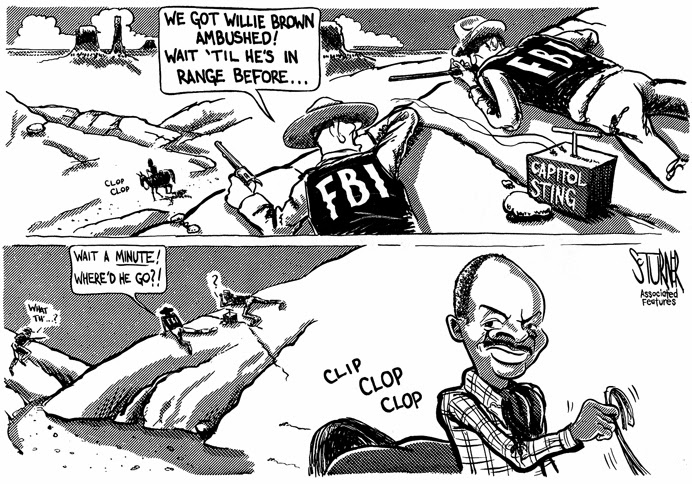
Former Assembly Republican leader Pat Nolan
Back in the day, the sting was all about shrimp. FBI agents in the late 1980s posed as operators of a West Sacramento shrimp processing company, looking for help in legislation allowing their company to operate.

"Shrimpscam" sent to prison Assembly Republic leader Pat Nolan of Glendale, Democratic Sen. Joseph Montoya of Whittier, and Board of Equalization member Paul Carpenter, among other convictions.

The sting also targeted but did not ensnare Assembly Speaker Willie Brown, Democrat from San Francisco.

Editorial cartoons are weakest in the wake of blatant graft because:

(1) It's a softball pitch, and the wickedest swing at the subject usually fouls it off. Only the most gifted cartoonist can match the height of corruption with the pinnacle of satire. The corruption alone should stand alone as the biggest joke.

(2) Cartoons often require a learning curve, a history lesson before the joke or satire has a chance. There's a good chance constituents don't care their representatives may be living it up in Las Vegas on the take. Chances are they don't know who their representatives are.

Which may be the first problem.

Thursday, May 2, 2013

Michael Ramirez also go boom!

Every so often an editorial cartoon educates and enlightens me, which happened with Michael Ramirez' 'toon this week, above.

Though I had no idea the topic, the visual metaphor is lightning quick despite its devastating weight.

(By the way, it's so hard to keep track of what's going in the world, and it gets worse every day even as information builds to a torrent, isn't it? I blame myself almost entirely, succumbing to the beguiling filters and baffles of irrelevant TV and celebrity news, ignoring 10 world events for the sensationalism of one. What news I manage to pay attention dismays and disorients me.)

I had to find out what the hell Ramirez was talking about — to the Internet, Batman!

Gosnell is Kermit Gosnell, a Philadelphia doctor on trial facing charges of killing babies born alive, and of killing a woman by a drug overdose during an abortion. The jury is deliberating after six weeks of testimony.

Prosecutors say Gosnell delivered babies and then snipped their spinal cords because he didn't know how to perform late-term abortions, while Gosnell's attorney says the doctor performed abortions while the fetuses were in the womb. Gosnell's attorney said the woman died instead from unforeseen circumstances.

A two-time Pulitzer winner, Ramirez 'toons for Investors Business Daily; such is the state of our traditional newspapers that a top award winning cartoonist would now work in the narrow margins of specialty journalism, seen online more than in print.

Ramirez runs far to the right of my opinions, but he wins me by his mastery of art; I look at his stuff even though I know eight times out of 10 it's gonna be about anything-Obama-does-is-bad-because-he's-not-the-second-coming-of-George-W.-Bush.

Few are better than Ramirez at taking advantage of better printing and digital dissemination. The painting effects he applies to his black line art amplify rather than muddy the image, are inextricably woven into the picture. Note that he has even painted the shadow of the barbed wire on the children's faces.

This one surprised me; this one lured me in the way I'd find it impossible to avert my eyes from a car wreck, wondering frantically what happened, what is what.

Right away I saw the visual metaphor for the sign above the gates at Auschwitz, the one promising prisoners Arbeit Macht Frei — work will make you free.

Then I saw the doors to the ovens, the analogy that the babies Gosnell allegedly killed were disposed of dispassionately as so many Jews and other threats to the Nazi state. Then I saw the children; then the shapes (window hatches?) within the ovens, together with the openings forming haunted eyes; I'm guessing it's intentional, maybe even a spectral caricature of the bespectacled Dr. Gosnell.

This cartoon will receive letters of damnation and praise and threats and the usual calls for Ramirez' firing, as happened when last week The Sacramento Bee's Jack Ohman blamed Texas' lax regulation on the West, Texas fertilizer plant explosion. Or maybe not; maybe his readership is largely limited to the choir.

Here Ramirez unleashes all the power of his pen, skewering me in the gut. His 'toon is a too-sharp mirror, making me reflect and question myself.

I believe in a woman's right to choose. I also believe in the power of education to make the best of that choice. I hear some of you: How could I have lived this long so naive, eyes half-closed to realities?

If Ramirez' statement railed against this trial alone, it would be an outrageous stretch, equating the Nazi mass extermination with, if the jury convicts, a callous if not miscast and misguided doctor. Given Ramirez' long documentation, though, I'd say he is condemning all abortion, at least late-term abortions.

Still, it's outrageous and raw, and Ramirez did his job expertly. He got my attention. He taught me something. The image lodges uncomfortably in my conscience.

Tuesday, April 30, 2013

Jack Ohman go boom!*

Jack Ohman is good. Like the world needs my opinion.

Even after the Internet made viewing the world's editorial cartoons a mere matter of mouse clicks, I liked to pick up the Portland Oregonian anytime I was in the vicinity, mostly to see Ohman's latest cartoon.

(Cartoons are best read in your lap or at the breakfast table, your nose to the ink, examining the work.)

He has a distinct painterly style and a fierce voice. He knows precisely the power of the editorial cartoon; he knows not to waste his space and your time with the visual equivalent of a Jimmy Fallon topical toss-off.

Ohman joined my neighborhood newspaper, The Sacramento Bee, this year, after his best friend, cartoonist Rex Babin passed away. Ohman said he made the leap to help raise Babin's young son.

Babin had a spare, reductive style, as if he was carving away his cartoons from blocks of wood or linoleum. His voice as well was understated and circumspect, with occasional pointed jabs.

Ohman has brought a wealth of explosive devices to the job.

Last week he lit up the sky with the cartoon above.

In the wake of the explosion of the fertilizer plant in West, Texas, so horrible and vast and somehow swallowed up in the sensational Boston Marathon bombings, Ohman blamed the explosion on Texas' lax industrial regulations, touted as a benefit to California businesses looking for cheaper operating locales.

Oh, man!

The 'toon went viral, major newspapers reporting that Texas Gov. Rick Perry got mad. Perry told The Bee:
“It was with extreme disgust and disappointment I viewed your recent cartoon. While I will always welcome healthy policy debate, I won’t stand for someone mocking the tragic deaths of my fellow Texans and our fellow Americans.
 
“Additionally, publishing this on the very day our state and nation paused to honor and mourn those who died only compounds the pain and suffering of the many Texans who lost family and friends in this disaster. The Bee owes the community of West, Texas, an immediate apology for your detestable attempt at satire.”
Other letter writers said they failed to see the humor in Ohman's insensitivity.

Damn right it's insensitive — but not for its own sake. Ohman's job is not comic relief; it's sardonic dyspepsia. Ohman upholds editorial cartoons on the same serious level as editorials and columns, and uses the directness with which the written word can't compete.

The Bee stands by Ohman, who defended his work in a newspaper blog:
… what normal person doesn't mourn those poor people fighting the fire and living by the plant? I certainly do. What makes me angry, and, yes, I am driven by anger, is that it could have been prevented. I guess I could have done a toned-down version of the cartoon; I am not sure what that would have been, but I think many readers' objections just stemmed from the fact that I used the explosion as a metaphor, period. The wound is fresh, the hurt still stings.
Texas hadn't inspected that plant since 2006, Ohman pointed out.

To be fair, having to explain oneself in a blog defeats the purpose of a cartoon, but it's helpful in its expansion. Good cartoonists such as Ohman count on informed readers to know the issues, and then stomp around in the playgrounds of their minds, splashing ink.

A toned-down cartoon wouldn't have been worth publishing, much less drawing.

Ohman also gets a Sunday comic-sized space to satirize California politics, particularly the musings and meanderings of Gov. Jerry Brown and his corgi, Sutter, who comments on the lunacy a la Pat Oliphant's Punk. Ohman has an interloper's view of California, without any cows to hold sacred.

Here's a recent one, with entertaining riffs on art history:

His stuff is well worth visiting.

Read more here: http://www.sacbee.com/ohman/#storylink=cpy

*to borrow from the colorful patois of kids (or at least TV commercials) these days …

Tuesday, April 17, 2012

Titanic excuse

Gov. George Deukmejian basks in elder-statesman status now — and actually looks good compared to some of the
doozies who followed — but he was a true Reagan Republican. In other words, he believed the haves should have more, and the have-nots should simply pull themselves up by their own bootstraps and magically become haves,
like all right-thinking Californians.
The most important part of commemorating the 100th anniversary of the Titanic's tragic sinking, of course, is that it gives me the flimsy pretense to post editorial cartoons about sinking ships.

I was the first editorial cartoonist to use sinking ships as metaphors for epic failure, or for our elected leaders abandoning the people they serve. OK, so maybe I was the 8,341st. Nit pickers!
Of course, Duke (as no one called him) had help in dismantling the state, from the normally unsinkable
Assembly Speaker (and former San Francisco Mayor) Willie Brown.

Tuesday, January 24, 2012

Hollow condolences

My self-assigned mission as an editorial cartoonist back in the 20th Century was to change the world, to kick ass and take names. I wanted the powerful to weep in remorse, to repent and reform.

My reach, in other words, exceeded my grasp.

Every once in a rare while, I kowtowed. Thus, this 'toon.

The 49ers had just trounced the Denver Broncos 55-10 in the Super Bowl™®©.

I probably needed a break from revolutionary zeal and decided to play to the partisan (Stockton, Calif.) crowd, and anointed quarterback Joe Montana and wide receiver Jerry Rice in one of the lamer cliché go-tos for any cartoonist, The Creation of Adam in Michelangelo's Sistine Chapel.

Maybe, just maybe, I probably thought. someone would see Joe and Jerry — someone who doesn't usually read the editorial page — and linger a bit before going elsewhere in The Stockton Record.

From sketch to finish, though, it felt false. I wasn't a fan of the 49ers at the time, and I'm not really now; in fact, during that Super Bowl™®©, I was hiking the quiet lonely streets of San Francisco with my wife and brother- and sister-in-law.

I stopped being a football fan during high school freshman football, a languid nanosecond after I discovered that with a certain vector of force, my knees can also bend sideways. (I'm squirming in my office chair just trying to type this sentence and fight off that memory.)

From then on, I couldn't see the point of football.

It was different when I was a kid and invincible. Football was everything. Those old NFL Films recaps of the week's games were like steroids to me. I'd stoke up on the John "The Voice of God" Facenda's baritone rumble as he narrated the highlights in poetic, patriotic gravity. Massive football players would break tackles and teeth in slow motion — always in slow motion — churning turf and sweat and steam as they galloped down field.

They ran to an odd mix of music from Sam Spence, either manic riffs on 1970s detective movie soundtracks, or martial drum- and horn-driven orchestral arrangements of folk music such as "Greensleeves" and "What Shall We Do With a Drunken Sailor?" (Really? Really.)

I'd run out to the front yard with my football and evade drunken sailors for open field-runs until sundown, humming that tune all the while. Football was cachet in the schoolyard. Catch a pass and the other boys deigned to accept you. Catch a touchdown pass and you became a hero. Intercept a pass for a touchdown, and you basked in simultaneous reverence and revulsion until recess was over.

When I was eight, I announced my plans to play professional football. When I was eight, my parents explained that the odds of me becoming a pro lay overwhelmingly against me, that careers get cut short and players become crippled in their early old age.

I still don't really know if my parents were dream killers, scared to death for me, or imbued with superheroic powers of practicality.

My team then was the San Francisco 49ers. Except John Brodie was the quarterback, and Gene Washington his main receiver, Ted Kwalick the tight end. And that exhausts my memory of that team, because just like every other kid, I never watched an entire game or followed the season. I wanted only to go out and play.

Except I remember that another wide receiver on the Minnesota Vikings was also named Gene Washington. "What were the chances?" I remember thinking. How weird for them, getting confused for one another at restaurants and so forth.

Funny what fascinates an eight-year-old.

And I got to go to a game with my dad. With the magic of the Internet, I now remember that it was Dec. 10, 1972 (I was in fifth grade), and my aunt's husband had given us the tickets to seats on the very top row under the lip of Candlestick Park's rim, which was designed to catch and hold the chill, whistling wind all game long. Somewhere down on the field, far far away, the 49ers shut out the Atlanta Falcons, 20-0.

The 49ers' glory years of Montana and Rice and Dwight Clark and Steve Young passed me by while I became interested in other things. I kept a weather eye out for the team this year because new coach Jim Harbaugh found a way to put a struggling quarterback, Alex Smith, into a new setup (don't ask me what it is; the terminology flummoxes me) and win their way to the playoffs. The team's last-minute win over the New Orleans Saints two weeks ago may go down as one of the best ever playoff games.

The 49ers lost last weekend to the Giants (no news to you), setting up a boring Super Bowl that's already set off orgasmic convulsions of delight for the East Coast entertainment empire.

The team had a Cinderella season. I might watch a game or two next year.

Tuesday, July 19, 2011

Hopelessly devoted

This is one of my favorite cartoons from way back when, the one that convinced me I could kinda sorta maybe carve out a living as an editorial cartoonist.

It also exposes my devotion to Pat Oliphant, the dean of editorial cartoonists (OK, say it: I'm an Oliphant sycophant). Among the many I admired at the time — including the late Jeff MacNelly, the late Paul Conrad (who in a letter told me to learn how to draw; I leave you to judge his opinion; I didn't take it well), the latest Pulitzer winner Mike Keefe — Oliphant was the only one I "listened" to. Maybe a little too closely.

(Fun-like fact: Oliphant, Conrad and Keefe all won Pulitzers while drawing for The Denver Post. Pedestrian coincidence, or alarming syndrome that requires our brightest minds and tenacity of the American spirit to stop? )

Backstory: Eugene Hasenfus allegedly was a CIA "cargo kicker," delivering supplies to Nicaraguan contras, fighting the government of Nicaragua. Hasenfus' plane was shot down, and Hasenfus was found with a "black book" containing damaging phone numbers and information linking the Reagan administration (and CIA Director-turned-faithful servant-turned-president, George Bush) to a suspected trifecta of delivering U.S. weapons to Iran at exorbitant prices to fund the contras. Hasenfus, sentenced to 25 years in prison in Nicaragua, returned to the United States in an apparent "spy swap."

The 'toon shows then-Nicaraguan President Daniel Ortega (who returned to become the current president) "shopping" Hasenfus to Reagan to complete the cycle of conspiracy.

I like the cartoon because of the spare composition that still establishes a street and a building, and because I had started to "shut up" with the text; in early cartoons I seemed to write all over the negative space. (Hell, the truth is I like to draw because I like looking at what I eventually draw. That others might see the art and feel some effect from it is icing.)

Looking over the collection of Oliphant cartoons my friend David Middlecamp recently bestowed on me, I'm reminded, with not a little embarrassment, how much I followed Oliphant's style.

Here's Oliphant's 'toon on the same issue, October 1986: Though he thought enough to chronicle it at all, he regarded it as a piffle in the greater scheme of the Iran-Contra scandal.

It does not reveal so much my mindful attention to his composition mastery. Maybe in future posts I'll embarrass myself on that subject.

On the larger issue of the Iran-Contra scandal, and U.S. covert operations in Central America, Oliphant was memorable and bitter. The cartoon below shows his mastery of linking one bleeding wound to another in one inexorable flow of misery, and reminding us, even as we continue in this manner, that we learn little from war:

Thursday, May 19, 2011

Politicians have affairs. Also, water is wet.

Must honor … my personal moratorium … on that former governor … of California … who now has admitted to his philandering. Only wonder … what will become … of … his "Governator" cartoon extravaganza. Knowing the way the world works … probably become … a mega-hit.

Luckily politicians and affairs go hand in hand, as it were, to the point that infidelity could become a major new political party. I was just reviewing a rogue's gallery — and what a long gallery it was, as if they all figured fooling around is a perq of office — of politicians who had affairs and denied them, even railed for political gain against the tearing of our social fabric by heathens and scoundrels and sodomites (the ones you have to watch out for, of course, are the ones who rail the loudest and longest; they're the ones likely participating in the things they denounce). Among the rogues, Sen. Gary Hart of Colorado, the 1980s version of John Edwards, so chock full of hope and charisma, how could he not become president and lead our country to the promised land? But rumors of an extramarital affair spread, and Hart, that clever tactician, challenged the news media to tail him, which they did, to find him in no time with Donna Rice, including on the yacht Monkey Business:


Donna mastered the art of turning a scarlet letter into fortune and fame, representing something called No Excuses Jeans.

Occasionally I piled on against other philanderers in cartoon form, but I'll save those when the need arises.

Two technical notes: Here is another unpublished square cartoon (right); for whom I can't remember. Also, I signed the top cartoon "Esti," which I did for a short while (the phonetic spelling of my initials). Coincidentally, my son has named a side business after the phonetic form of his initials. I know, riveting stuff.

Friday, April 22, 2011

Hope-y Earth Day

I'm following my own advice.

Back then, global warming and melting ice caps (not to mention the loss of glaciers from Glacier National Park and Joshua trees from Joshua Tree National Park), were scarcely contemplated.

Those were the days, my friend.

Thursday, April 21, 2011

Joe, we know ye too well

Last week Vice President Joe Biden was caught napping (or at least closing his eyes for a long period) at President Obama's here's-how-we-fix-our-budget-mess news conference. It was much ado about very little, the kind of thing the news media converge on because the real issues are too hard to understand and report.

Joe was sleeping way back when too, when he was caught plagiarizing, word for word, a speech by British Labour politician Neil Kinnock during his run for the presidency; that was the end of Biden's campaign. I drew Joe Biden borrowing from Nixon as his parting shot, thinking that was the last of him. But politicians never do quite go away, do they?

This is one of a bunch of cartoons that I drew in a square format. I must have been shopping the cartoons to a publication with a square hole in its editorial page, but I can't remember which.

Monday, April 18, 2011

Only the little people pay taxes … due today!

"'In this world nothing can be said to be certain, except death and taxes," said Benjamin Franklin (and many others in many forms). Also, cartoons about taxes, since the core issues never seem to change.

Keep your chin up and stand proud that you can pay taxes. Some, like General Electric, can't afford to pay any taxes …

Thursday, March 31, 2011

You spell Gaddafi, I spell Khadafy, you spell Qaddhafi …

The more things change …

Twenty-five years ago this week, The U.S. was preparing to war with Libyan leader Khadafy …

Hmm. Not entirely sure the message I was trying to send. Police dog to the World, the United States,
might be sniffing around a number of countries, but then found motivation with the crazy Libyan leader.


These cartoons were for The Hanford Sentinel, when I was just getting started on what an editorial cartoon should be.

Three days before the cartoon above, U.S. and Libyan aircraft had clashed in the Gulf of Sidra on Libya's coast, and four Libyan attack boats were sunk. This was another in a simmering sequence of tense clashes with Libya, tied to terrorist attacks against U.S. and British targets. In April, terrorists bombed a Berlin nightclub, killing a U.S. serviceman and injuring some 50 more among 200 people hurt in the blast. The United States unleashed Operation El Dorado Canyon, bombing Libyan targets.

(Before we go on, could the United Nations or someone organize a standardization of Khadafy's name? Virtually every other world leader's name is spelled the same across the news media. Why not his? It's not just his last name, sometimes spelled with the prefix al-, as in al-Qaddafi; his first name has almost as many variations, including Moammar and Muammar . Maybe this is a part of the chronic problem: He's not getting the world's tea cards asking him please to stop brutalizing his people.)

Again, my meaning is unclear, though the name, Tommy Tonkin, alludes to the United States' penchant for
manufacturing provocations for war or violent "nation building" (as in Gulf of Tonkin incident). Though not alone in this practice, the United States is especially good at it. The same with warring in the name of idealistic principles when in truth it's almost always for business. The new "no-fly zone" looks and feels like more of the same.
President Obama just went to the airwaves to explain this generation's bombing of Libya, dubbed Operation Odyssey Dawn (which Jon Stewart described as a Yes album, Stephen Colbert called a Carnival Cruise ship, and Lily Tomlin said was a bad name for a drag queen.)

As with his predecessors, President Obama has aspired to irony. I give him no argument about stopping a brutal leader from harming his own people, but as with the others who have made the same justification for war, I say, "Yes, but …" As in "Yes, but the people of Yemen are suffering in a similar fashion. Why aren't we stopping its government? Or Syria's? Why aren't we bombing hell out of those who massacre in Congo, Somalia and, for that matter, Mexico?"

It can't be just because we can't stand to see a government harm its own people, because quite clearly we can. It would be refreshing if our leader said, "Look, we can't intervene in Yemen because we have a military base there and we've got it pretty good with the government . Libya provides oil with fairly close access to our European allies, and we don't really have anything cozy going on with Mr. Khadafy, or however you spell it." Or something like that.

It would be depressing, but I'd prefer it to the same stirring rhetoric that belies its true aim. Then again, what would have cartoonists have to draw?

President Obama says action against Libya should eventually force Khadafy out because "history is not on his side." The guy's been in power for 40-some years; I think he's got the history racket worked out.

Get ready for another long, painful entrenchment.
Lord, I was wordy in the early days. That's a lot of ink to point out that the U.S. was practically alone
in this attack and President Reagan was less than skillful in getting help
. One difference this time — apparently — is that France and Britain are taking more of a lead.

Friday, January 28, 2011

Challenger

(Today marks 30 years on, that the tragic explosion of the Challenger scratched its arcing demon horns into the Florida sky and our memories. I figure this is worth another mention:)

Twenty-five years ago today, the space shuttle Challenger blew up after liftoff, killing her crew, including the first teacher in space, Christa McAuliffe. This cartoon was my visceral response; a reporter for The Hanford Sentinel, I had talked my editors into letting me draw editorial cartoons too (more on that down the road). The disaster took place on a Tuesday, so I would still have had a full day of reporting duties, and was likely designing and editing the agriculture page as well. I must have drawn this after the workday was over, and the editors put it in the next day's paper. (I believe it won a California Newspaper Publishers Association award.)

Among the touchstones of my life is Apollo 11, the crew of which returned to earth on my seventh birthday; it still gives me chills to imagine humans having walked the moon. So I thought of Challenger as a child might, and responded as a child (me?) would. It was one of the worst experiences to have had to share with others by that point in my life; bitterly funny, since so many even more horrible events have taken place since.