Showing posts with label swimming. Show all posts

Tuesday, December 15, 2015

Ties that bind

My facebook™© feed has already blossomed with ties, most of them knotted around the necks of semi-naked bodies — all symbols of support for a woman many of us know but have never met.

Swimmers have rallied around her.

She is Helena Martins, and last week in south London, a man attacked her as she walked home from work. She said she believes the attack was because she is lesbian, and that the tie she was wearing became some kind of signal to the attacker.

The attacker punched her in the eye and choked her with the tie. Read more here.

On facebook©® afterward, Helena wrote:
I don't think I'll be rocking a tie in the near future.

Today, one street away from my home, I was assaulted by a man who just went berserk at me, trying to pull my tie off.


I've got a scratched and punched face, a sore neckline by all the tie pulling and a very bruised soul.


I did fight back a little, but when I saw my (cochlear) implant being tossed around on the floor and stepped on, I just wanted the guy to leave me alone and crouched against the wall with my hands and arms above my head and chest.


The all thing was over in 2 minutes.


Please. Homophobia Transphobia are still very much alive. If you hear or see someone making fun with pub jokes, harassing or bullying of LGBT people, making comments while watching TV or a movie or whatever...

Act. Speak out.

Your silence makes them feel that they are right. They're not.

Tell them. Please. Be part of the solution, not the problem.


Some women wear ties, some men wear skirts. Get the heck over it.

One thing is true: I shouldn't be punched in the face for wearing a tie.
Helena became deaf as the result of Ménière's Disease, a disorder of the inner ear that can also cause severe dizziness. The attacker may have identified Helena as an easy target, she said, mistaking her unsteady gait for inebriation.

Almost immediately, swimming fans rallied and began rocking ties. Fiona Bettles, like me, doesn't know Helena personally, but follows Helena and a myriad other swimmers in their daily open water and pool endeavors. She's among several who are organizing today, Tuesday, for wearing a tie in support of Helena.

Swimmer Suzie Dods posted the same on the Marathon Swimmers Forum. The grassroots campaign is #tieforhelena.

Here's my bid.

Many swimmers didn't wait for today, instead showing up at their group events over the weekend in (swim)suits and ties. Their sartorial choices made their way on facebook™® over the last four days.

Helena Martins, as well as those who have stirred this campaign, urge supporters to stand up and speak out against homophobic and racist attacks. Scotland Yard reported that homophobic attacks in London had increased by nearly a third in the year between July 2014 and July 2015.

Rock your tie today.

Friday, October 30, 2015

Water color

Call it a niche hobby — designing emblems or marks for swimmers' grand endeavors.

I created one for Annabel's English Channel crossing earlier this year.

More recently I did one for Katherine's attempt of the Catalina Channel between Santa Catalina and the Southern California mainland.

The latest (left) is Lisa's, for her planned crossing of the wide Monterey Bay in the near future.

She wanted something that commemorated the process more than the achievement, and gave me a grocery list of inspirational possibilities:
  • Paddleboarder — we’re a team. I doubt I'd be distance swimming without him. 
  • I have my sights set on Monterey Bay, which, apparently is a super difficult swim. What do I know, I'm just a dreamer. I swim in Santa Cruz, I swim in Pacific Grove. Just thought it would be cool to swim from one home beach to the other. Really nothing more to it.
  • Moss Landing twin smokestack: I see them from both Lovers Point and Cowells.
    It's halfway. 
     
  • I'm a birdwatcher. It’s an unofficial sub-group within the Kelp Krawlers. We’re the ones too slow to keep up with the “A group,” they’re the fast triathletes who swim all the way to the buoy. 
Katherine's request was more open-ended, but specified
her love of garibaldis, the state fish. I tried to depict the
night-to-day nature of the long Catalina Channel swim,
and the iconic start (though the swim doesn't actually start
from Avalon or its casino) and finish near Palos Verdes.
  • We’ve been training in Monterey Bay, San Francisco Bay, and Carmel Bay: Santa Cruz to Capitola, SF to Berkeley, Berkeley to Treasure Island and back, Carmel Bay double-crossing. In addition to Alcatraz and the Golden Gate Bridge, the Berkeley clock tower. Carmelite Monastery became beloved sighting landmarks this summer. 
  • The yin and yang of breaststroking. Breaststroking as a handicap (slow, energy inefficient), breaststroking as an advantage (chop, tracking). 
  • Filipinos aren’t known in the sport of swimming. 
  • I LOVE Pelicans and cormorants. Instead of frog-kicks I’d like to think I kick more like a cormorant. 
  • Sharks. Seals. Otters. 
  • Our ocean monsters: Jellyfish...sharks... hypothermia. 
  • The Monterey Canyon
As much as I like to show my own process, I have little to show for Lisa's mark. Katherine's came quickly, starting with a representational human arm and head, and anatomically correct garibaldi. But I had done a fair streak of realistic and anatomically correct stuff, and was growing tired of it. Time to pare it to the barest shapes.

Repeating the paisley shape through water, light and eyes, I sought to bring the image together. And … done.

With Lisa's, I was stuck in the yin and yang, and didn't know whether to extricate myself or keep working with that idea. I like the yin yang symbol for its power to say so much in compactness, and like to play with the idea when given the chance.

I did the only rational thing. I left it the hell alone, letting it work itself out.

Annabel's English Channel mark
Meanwhile …

I had been playing with a marker, trying to get some illustrations done as fast as I possibly could because I didn't have a lot of time, wanted something different, and wanted to pursue saying more with less, doing less to say more.

I drew the simplest, scribbliest shapes, scanned them, then played with them in Illustrator™®, moving them in front and behind, making some shapes transparent, others solid, chopping them up, tweaking, tweaking.

It is raw and uneven and spontaneous and childlike.

It has become the new fun thing. Until the next thing comes along.

Then, while swimming, I saw my way out — by diving headlong into giant kelp.

I had been resisting kelp as an art element of Lisa's logo, even though it's really the unspoken common element in her grocery list.

I couldn't help thinking the Monterey Bay Aquarium had perfected the use of giant kelp in its logo, and ruined it for everyone else.

But the kelp's natural flowing precise elegance, its repeated pattern of bulb and frond, beckoned me. I had to use it.

The kelp became the sea in Lisa's logo, the words the sky. Originally it looked like this:

But Lisa asked that it read "One breath:"
"One breath as in one breath, that very first breath, can mean the difference between hyperventilating or being able to swim comfortably in cold water.

"One breath as in it takes just one breath to inhale cocci...


"One breath as in using the swim to breathe life into an otherwise unknown cause."
And the strawberries? They refer to that unknown cause.

Lisa is raising money for a scholarship to honor her former husband's late father, who engineered several strawberry varieties for a major berry producer in California. Lisa says she can see strawberry fields from some of her training swims.

Moroccan (top) and Tunisian flags
Algerian flag
I also got to design some swim-related flags for Sakina, honoring Arab and swimming culture at once, with these versions of the Algeria, Moroccan and Tunisian flags that Sakina wants to put on swim caps.

Algerian Berber flag
Besides bubbles, the symbols became sea shapes to reflect Sakina's Southern California ocean playgrounds.


Tuesday, July 21, 2015

Benumbed

First, thank you: When I reached out last week in this blog, seeking advice on helping a Ghanaian swimmer help others learn to swim, I imagined I was casting a message in a virtual bottle, letting come what may. But it reached you directly and you reached back quickly, with heartfelt help and mindful advice.
Many of you pointed me to the same person, co-founder Dan Graham of Nile Swimmers, a United Kingdom charity based in Sudan. Dan gave me a frank and thorough background on the scope of lifesaving efforts in Africa, successful but woefully underfunded against pandemic drowning. He advised me of the challenges and pitfalls of providing help remotely. Dan, in turn, pointed me to three organizations already doing similar work in Ghana, with whom my Ghanaian acquaintance might harness his efforts.

I'm hoping the next steps bring a good result soon …
It is no longer cold in my beloved Lake Natoma. At nearly 70 degrees Fahrenheit, the water is far warmer than I can remember over the four years I've swum here.

The current is strong, though. Water officials said they would slow releases from Folsom Lake into Lake Natoma in this drought, but it doesn't feel like they have. I have learned to swim against the current by hugging the north edge of the rocky ravine, a weather eye out for the canyon edges, which jut out over my head at times.

I'm finding eddies, some strong enough to swirl around and push me forward, then fighting against the rush of water as I round a rocky point, until the water relaxes and lets me into the next eddy. It's sneaking to the edge of Folsom Prison by the long route, but I'll take it. I have no choice.

Once up to the prison chain, I plow sideways into the middle of the channel, and feel my body fly back down the ravine where moments ago I had been climbing half-foot by half-foot.

I've been taking this for granted, I realize. The numbness I feel in in my hands in the winter water has this summer reached my head and heart.

Each morning this week, I have been swimming past a body, somewhere below in the green water.

A 22-year old man drowned in this water last Thursday. He and some friends tried either to swim across the lake or into the middle, and got tired. Kayakers rescued two, one swam back to safety on his own. The 22-year-old man disappeared. Recovery crews have yet to find him.

On my way up through the current toward the prison, I pass the rocky island near where rescuers last saw him.

He is one of six people in the last three weeks to have drowned in the rivers and lakes around Sacramento.

The other five drowned along the lower American River, or at the confluence of the American and Sacramento rivers, where the current can sweep unsuspecting swimmers over unseen drop-offs below the surface and pull them under.

The Sacramento has long been a river of industry, its bottom crowded with concrete slabs and poles and cables and downed trees and junked cars — there to catch a struggling swimmer.

The Sacramento Fire Department reports that an average of eight people drown in Sacramento's rivers each year – four times the national average. This year the terrible season started early, with a drowning in late and warm March at the rivers' confluence. The number of drownings has already exceeded the average.

Drowning, widespread far away, is also prevalent here, where we would expect the resources to prevent it.

I had been numb to it all, until that man drowned near where I swim. Now I mark his passing, looking shoreward to see if anyone has come to mourn him, looking to see if recovery teams have resumed their search that early in the morning.

Now I wonder how I could help stop the drownings. I have been blessed to be able to swim, blessed to have had help since childhood to overcome my fears and respect the water; blessed to have practiced open water swimming, first as a Scout leader, then with new friends passionate about the sport, who would not let me give up because of new old-guy fears.

I have been blessed to have time to swim my lake, to learn its ways, to learn to relax and be patience in current and high chop.

But I have lost touch. In the television news stories, I have heard experienced swimmers describe Lake Natoma as "extremely cold," and I have forgotten that for many people who rarely or never go into the lake, it can feel cold even in high summer.

I had forgotten that not long ago, helping Scouts learn canoe rescue techniques in Lake Natoma, the cold (64 degrees F) shocked me head to toe, arrested my breathing, chased away rational thought, began to induce panic.

Though I'm as snarky as the next skins swimmer, I'm not militant: If a wetsuit is what it takes for someone to swim the open water, I bid welcome.

I had forgotten, too, how frightening moving water can be, how futile it made me feel.

The city and county are taking new water safety steps after this horrible string of drownings, including new signs posted near the most dangerous landmarks along the American and Sacramento rivers, and rangers talking with beachgoers about the perils of swimming.

It already provides life vests on a rack at swimming holes along the two rivers, including the dangerous confluence. Many people, unfortunately, ignore the offer.

I'd like to do more, and as usual with most of my public whinings, I don't know what. I'm not trained to teach others to swim, and I'm not even sure encouraging more open water swimmers is even the answer. Though I do encourage anyone halfway interested to give it a try, as safely as possible along the shallow beach at the lower end of my beloved lake.

I would not swim where most have drowned, where the currents and undertows are swift even at low levels. Most of the victims weren't even swimming, but wading until they got too far out to come back. Only in a few instances have drownings resulted from hubris, swimming beyond ability and knowledge.

Knowing is key — knowing how to swim, knowing how to relax in the water, knowing where the life vests are, knowing where the water is dangerous. The education is often in English and many who drown here don't speak English.

I can do something. The numbness needs to go away.

Thursday, July 16, 2015

Ask, tell

My Mitty-esque idea for helping a cause.
Now for something completely different:

In which, rather than blather about questionable conduct in my own life, I ask you for advice about an important part of someone else's life.

I need your expertise – experience with similar problems and solutions, resources I can look into, alternate solutions I don't even know about.

Here's the story:

One fallout from facebook™® and its best page ever, "Did you swim today?" (about which I've blathered ad nauseam) is meeting people reaching out for this and that need.

One person I've met this way is Kabutey Emmanuel McCain. He lives in Accra, the capital of Ghana in West Africa, along the Gulf of Guinea.

He swims, but mostly he teaches people how to swim.

Inability to swim is epidemic in Ghana, I've come to learn, where people move by water to get places — along the coast, across lagoons, up and down rivers.

Drowning is a big problem during normal times, Kabutey says, and goes underreported in his country because of burdensome requirements to get official help.

These aren't normal times — Accra is recovering from last month's massive flooding in which more people drowned and scores died when a gas station exploded where people had taken shelter from the rains. It's one of those tragedies we don't hear much about in the West.

Kabutey is trying to help people swim, and teach them to rescue others, normal times or no.

Someday, he says, he'd like to run swim-and-rescue programs throughout Accra and beyond its borders. Right now, he and some friends work in their neighborhood, using the community pool or a friend's pool when the weather permits, teaching the neighborhood children.

His is a shoestring operation on a broken shoestring budget. He would like to get some cardiopulmonary resuscitation mannequins to teach lifesaving skills … transportation money to get him and his team around Accra … and means of publicizing his programs.

I met Kabutey through facebook®™ when he was asking individual DYSTers (what swimmers on the page call themselves) for help.

Some sent some. I learned how cumbersome it is to send even a few items and a bit of money from California to Ghana. Though the bit of money reached Accra fairly quickly, the items took weeks and weeks.

This method of sporadic and individual giving was not going to help anyone accomplish anything, I realized – neither Kabutey his goal nor his donors goodwill.

Kabutey needs another way to go about this. Namely, he needs
  • another resource that's more dependable than a small random hodgepodge of people, or
  • a wider audience
and
  • he needs to be able to manage fundraising on his own
So now he's trying crowdsourcing. I don't know much about crowdsourcing, except that it's a way for a lot of people to give a little in a fairly convenient manner, the little adding up to a substantial sum to help people solve problems just like Kabutey's.

He could manage and monitor it, having access to a computer and social media.

I've offered what I can, which amounts to writing copy and maybe supplying graphics for the cause, including the logo above, which Kabutey did not ask for. I live in my own world of imagination, but even there, my pockets aren't deep.

He's trying crowdrise.com, created in part by actor Edward Norton. It seems like a good fit.

But crowdrise.com requires that he have a U.S. bank account, meaning someone else would have to manage fundraising operations for Kabutey, rather than him managing on his own.

He can't post any information about his needs on crowdrise until he secures a U.S. destination for the money.

We're back to where this started. I'm uneasy, frankly, about setting up an account for this purpose, because I don't know the ramifications, the pros and cons.

So I need your advice and suggestions, people and resources I can consult:
  • Have you ever set up an account for a similar person, or know someone who did, who can tell me the perils and pitfalls?
    • Is there a way to set up a third-party account?
  • What are some other means he can use to meet his needs such as:
    • Grants
    • Existing funding sources in Ghana or Africa
      • Sources that serve Africa specifically
      • Sources that serve swim instruction, lifesaving and drowning prevention specifically
  • What ideas do you have about helping serve Kabutey's needs that I don't even know about (my ignorance being epic)?
I welcome any and all ideas and resources I can pursue, and thank you for your consideration.

Right now it feels intractable, but my gut tells me it isn't.

Thursday, April 30, 2015

Thumb drive

"You just have to be 10 percent smarter than the machine," says Will, a friend and fellow former Scout leader.

He has said this many times.

Or maybe I have just heard it many times.

Maybe Will has intuited the futility of this particular man against the machines.

Machines are winning.

The latest machine might deliver me the death blow.

I got a smart phone. Yeah, a dumb guy got a smart phone.

Playing hard-to-get with technology, I'm typically the last on my block or my continent to embrace these Tools of Amazing Convenience,™® Doing Things I Never Thought Possible or Even Necessary In Any Measurable Way!©®

I derided such devices as Whiz Bangs. "Get out your Whiz Bang," I'd say to my son. "Tell me where China Beach is from here."

A Whiz Bang of my own finally seemed necessary. At least that's what we're telling ourselves. I need it to conduct business remotely, since I'll be going to a job job but keeping my old job. The family, each of whom has embraced smart phones with something approaching ecstacy (meaning they might actually have affixed the free Apple®™ logo sticker on something others might see), has felt sorry for me.

They have all been helpful. Maura handled the basics, setting up the phone, taking me through "on" and "off" and "volume" and "lock" and "charger," and how none of this is possible without opposable thumbs.

Nancy has shown me some features while driving, but we shouldn't have been doing that so I won't mention it here.

Liam has been trying to solve remotely why my emails won't send from the phone, and how I can schedule my blog to post regularly and link it to a facebook®™ status update.

Which is the only reason I really need a smart phone.

I gave up my flip phone and accomplished all that seemed useful with it. Over the last four years I had moved through the Five Stages of Mobile Phone:
Indifference: I know I have a phone. I don't know where it is. I don't want to look for it. It's always bleating to be recharged. How do I make it stop bleating?

Empathy: My loved ones would like me to find my phone. They think it's a fine idea that I keep track of the phone so they can communicate with me.
Dawn of Man: I answer phone calls ("Are you there?! I can't hear you very well." "Well, neither can I!" "What?!") and learn to text, beginning with several months of the repeated opus, "k." My loved ones learn to frame statements and questions that can be answered with "k."

Renaissance Man: I can type "ok."
Acceptance: I text like a mad fool. My thumb can leap tall buildings.
I had come to love the cumbersome way to text with a flip phone, in which I have to press a keypad button a certain number of times to produce a certain letter, number or punctuation mark.

I got quite good at it, and the more I did it, the more it appealed to my vestigial childhood wonder about cyphers and codes and spies and secrets. They intermix with the wonder of magic and sleight of hand, and American Top 40®™ and animation and paleontology.

I have daydreamed in the last few weeks about a secret code based on my flip phone — a symbol for the position of the keypad button, say, and another symbol for the number of times to press the button,  equals a letter number of punctuation. Probably no punctuation; or maybe sometimes, to throw off the enemy.

How robust would such a code be? Probably not very. I wonder if anyone has made such a code.

I'm right back in third grade, writing notes in lemon juice to send to my childhood friend Lance, who would have to carefully pass the paper over a light bulb to burn the juice traces into visibility. (Owing to the shrinking supply of incandescent bulbs, lemon juice may come back in vogue as a spy medium.)

We each had plastic cards from Pop Tarts™® boxes, the cards incised with symbols. Trace the symbols in certain orders on paper to create messages, the meaning of the symbols known only to Lance and me. And anyone who ate Pop Tarts™.

Typing on the new phone is not code-like. It's foreign and unwieldy, my thumb pressing around every onscreen letter but the one I want. I am saved, grudgingly, by the predictive spelling feature which saves a lot of pressing and guessing.

But I press and slide and tap and double-tap, and pitch and spread my fingers and watch the images slide and bounce like cartoon characters at my sorcerer's gestures, and wonder at this technology, new to me, common to you.

Here's the thing, though: The phone is big. Bigger than my wallet. A phone is my watch, real watches falling off my wrist too frequently when the sweat of my arms saws through leather wristbands.

The flip phone fit in the palm of my hand, and I could hide it without too much trouble when leading a tour of the Old Sacramento Underground. I could direct visitors one way, turn the other and palm my phone out of my costume apron: OK, I'm right on time.

The new phone feels like I'm pulling a surfboard out of my pocket, and looks just as subtle. Tour visitors are going to wonder what the dude in 19th century duds is doing with this otherworldly device spilling out of his hands. (He is just trying to learn the time; look over there, please.)

I have no particular need for the phone 99 percent of the time. I take it out with me to lunch, checking facebook®™ (you can fall far behind if you're not vigilant, which you know). I have even taken photos with the phone. I have even found where the photos are that I have taken.

Yesterday I pushed myself to the technological zenith: Before finishing a three-mile swim, I climbed out onto the far shore of Lake Natoma, took a photo, called up the Internet, checked the water temperature, posted my swim on facebook®™ to other swimmers, and attached the photo — all before I had even finished the swim — and then got back in the water to reach the dock and my car.

In the old days I went home, post about the swim — no photo — sometimes hours after the fact.

No more. A new era has dawned.

The phone sits at my elbow as I type, a black obelisk as imposing and mysterious as in 2001: A Space Odyssey. It holds unimaginable power, untold wealth of capabilities and conveniences.

I sense its urge of obligation, like The Ring to Bilbo. I won't see the masses, together but alone, gazing down into their machines anymore … because I'll become one of them.

Ummm.

Maybe tomorrow. Although: What time is it?

Thursday, April 2, 2015

See and be seen

Cameras: Good or evil? Discuss.

I'm in a love-hate relationship with cameras. Eighty-five percent hate. No, 90 percent …

… Ninety-three percent hate, 7 percent love.

I'm lean on the love.

I hate being in front of a camera (creeping petulance) as much as behind one (childhood anxiety).

Social media, then, has rendered me useless.

If ever you see a selfie I've taken, know that the Apocalypse has come.

The 7 percent love I reserve for good photography and photographers. Also I'm not above using photos for reference in drawing. I'm just not good at photography. Likely I'm jealous. Maybe because I have always liked to draw and deep down I think photography is cheating, somehow. Sure, stand before landscape, press a button and leave, while I'm still drawing this umpteenth leaf!

Which is stupid, of course, because I know photographers who can make the world sing fuller than life with their work. Thankfully our kids did not carry my aversion to carrying cameras, and like them as a tool of art and documentary.

My grandma gave me a Kodak®™ Brownie® when I was eight or nine. I think it was a Brownie® Hawkeye™, a round-edged cube of bakelite™® the color of dark roast coffee. You looked down into the magnifying-lens viewfinder, pressed the button, then turned the knob on the side to advance the film.

It was the age in which things are tossed at children in hopes something sticks, a future forged. Here's a book: Maybe you'll be a scholar. Here's a microscope, kid: You're gonna be a scientist! Models, paint sets, magic tricks, all part of the parent-child parry and thrust of Whatever Will He Become?!


Parents long to see this in their hometown newspaper: "Well, my mom brought home a chemistry set, and that's really all it took. Sorry, is my Nobel Prize blinding you?"

The camera was one of those offerings of hope. And I loved it.

I loved the potential of it, anyway.

The Brownie was the ideal gift since we were just then making a trip to Disneyland®™, grandma in tow. Not only joy, but archived joy!

I got sick. Really sick. Earache, flu-like, what-the-heck-is-the-matter-with-him? sick. Not sick enough to cut the trip short, just too sick for me to care about Disneyland®™ or living or breathing.

At night I lolled in agony in the motel room, keeping my parents up round-the-clock.

By day the PeopleMover®, now defunct, became my friend, snaking about Disneyland®™ at not quite enough speed or amplitude to induce vomiting. On the occasions when my vision cleared, when extreme gravity wasn't pulling the camera violently from my hand to the ground, I took pictures.

None of which you'll see. None exists.

Excited to look back on my Disneyland®™ trip and reclaim good memories from the barf bag, I got my film back from the base exchange to find: I had doubly exposed every image. Every single one. Even triple exposed some.

Grandma ghosted into the topiary … the Matterhorn collapsing into the parking lot … Cinderella's castle crash landing on Knott's Berry Farm … Mickey Mouse as the manic gremlin in your daymares.

See that knob on the side of the camera? You have to turn it after every press of the button. I forgot and forgot and forgot.

I've disliked cameras ever since.

Silly, right? But there you go.

Bad luck, too, since I had to use a camera in my early years as a news reporter. Humble apologies, still, to my readers.

I just could never get what I see with my eyes to come out on film. I took one photo class in college. Ansel Adams was in the class, I think, and shredded the curve. Even when I got the blacks black and the whites white and the midtones ideal, it was always the same: C+.

Being in front of the camera is another matter, to which I summarize: Harrumph!

Also, Why?!

I'm of the age in which all would-be photos of me are group shots, mostly with family, some with friends. Different combinations of people, different backgrounds, same basic concept.

Stand close together. Closer! You're going to have to lean in. Lean in, I said! Now smile! Come on, smile! You always do that!! Why can't you smile?! Now we have to take another!

My dad delighted in screwing up group photos, pulling a face or flashing a finger. Maybe he just didn't like photos of himself, either. If given no other choice, I carry on the tradition. There aren't a lot of photos of me. Memories suffice for me; my pockets are chronically empty of cameras.

Here's the thing: In my mind I'm tall and thin and lithe. A mirror, conspiring with my brain, will sometimes even bear this out. A camera, with one exception, will betray me.
The miraculous exception: My son
captured this of me returning from
Alcatraz. Everything flexes except
for flab, cleverly hidden by limbs.
(Also, it's nearly four years ago,
so less flab to camouflage.)

I know at my core I'm not supposed to fret about body image, but the superficial me has a big mouth and won't shut up.

What few photos emerge of me anymore involve swimming, where after a lifetime of feeling need to cover up, I have laid myself nearly naked to the world, and do so almost daily. That's a big deal for a lot of swimmers, I think, this coming out. It may even be a needless barrier that keeps people from swimming.

No illusions remain for a body stuffed in jammers — the longish swim shorts I wear — and the camera's truth is brutal.

Recent swimming candids reveal: I am not thin and lithe! One could say, with oblique politeness, that I probably float well.

Oh, well.

The truth hurts, but also helps. The camera's honesty reminds me I could stand to lose some weight, for a variety of reasons. Faithful swimming alone is not enough.

Stringent additional measures are called for. Vigilance is all, less for vanity than vitality.

Maybe in the near future I'll have blundered into view of a camera and look closer to the person in my mind. Just don't expect a photo op.
. . .

In other news: Gov. Jerry Brown got hold of my Tuesday post, thank goodness, and finally implemented emergency measures to save water in California's unprecedented drought. Maybe two years too late, but it's not nothing.

"We're in a new era," Brown said yesterday. "The idea of your nice little green grass getting water every day, that's going to be a thing of the past."

 You're welcome. Now, do your part!


Thursday, March 12, 2015

Kiss the buoys and make me cry

Clong! sang the buoy.

It's big as a washing machine, round and spiky and metal as Sputnik, a bobbing yellow enamel-coated and tattooed orb, glinting in the sun.

It's not supposed to sing or make noise, though. It's not that kind of buoy.

It was made to monitor time and tide, discreetly despite its sunny hue.

But it had never met my two front teeth before.

More on that later.

The buoy would get no attention at all if not for regular visits from the Kelp Krawlers. They're open-water swimmers who use the buoy to mark routes through the marine sanctuary off Pacific Grove in Monterey Bay.

My wish to swim with the Kelp Krawlers is almost as old as my wish to swim open water. While dreaming of an Alcatraz crossing four years ago, I began to dream of joining the Kelp Krawlers in the gorgeous and foreboding Monterey Bay, a place I have visited vicariously through writer John Steinbeck and biologist Ed Ricketts and painter Bruce Ariss.

But finding a way to be in Pacific Grove at 11:15 on a Sunday, when the main group meets, has proven harder than I thought.

It happened for the first time last weekend, and only then because Nancy and I had dropped her mom off to visit friends farther south, and were making our way home to Sacramento. Still, we weren't certain we could stick around. Daylight Saving made it possible, though, the time change robbing us of an hour but shoving us that much closer to the swim start time.

Heaven ain't Iowa. It's Pacific Grove. Though largely unattainable, like heaven, Pacific Grove at least has generous visiting privileges. Dozens of available parking spaces line the rocky storybook coastline on Ocean View Boulevard. Take your pick, especially at 9 a.m. on a Sunday.

Which we did. We were very early. I was eager.

Finding a space close by Lovers Point (fun fact: It was once called Lovers of Jesus Point as a church retreat venue), we passed the hours walking along the trail that overlooks the rocky coast, its massive adobe-colored boulders softened and lacerated by time and wave, and dotted here and there with resting harbor seals.

Pacific Grove is hyper-real, hyper-California, the Eyvind Earle postcard you'd send to your snowbound relatives to make them hate you. You half-expect a truck commercial to break out at any minute; to turn a street corner and suddenly find yourself in another section of Disneyland®™.

You can walk right along the shoreline through carpets of delicate ice plant, amid towering succulents with red and blue rockets of flowers, all the way north into Monterey or south around the point to the state Asilomar retreat if you want, right in front of grand sweeping houses, right before the great sweep of the dark blue bay.

I always thought that if we ever won the utterly remote chance to live in Pacific Grove, we'd never own a TV because we'd spend morning and evening down by the ocean, always finding something better to watch.

It's always a treat to visit, and next I was going to swim it.

The Kelp Krawlers are a big bunch, 30 or 40 of them gathering above Lovers Point Beach, and that isn't even the largest gathering, I'm told. It's lucky if two other people join me to swim my beloved Lake Natoma.

A guy named Chris was shepherding the Krawlers, gathering them up in the parking lot. All but four were wearing wetsuits. One who was not, besides me, is John Ratto, whom I've met through my favorite facebook®™ page, "Did You Swim Today?"

John lives in Pacific Grove. He said he owns a TV. His loss.

The beach at Lovers Point is a smaller replica of the cove far south in La Jolla, where I got to swim last April. Each features a terraced stone-and-concrete amphitheater that drops from a lovely park to the water and opens northwest to the curve of land in the distance. Lovers Point Beach faces the redwood-covered hills that rise more than 20 miles away, above Santa Cruz at the north end of the  bay.

In each place, the bright sand beach and topaz shallows form the amphitheater stage, inviting you in.

At an unseen signal, all the swimmers began making their way down to the stage, past beachcombers beginning to stake out their morning.

Most of the Krawlers were heading north to the round yellow buoy, about a mile round trip. I opted for the smaller group swimming a triangle of about a mile and a half around two buoys.

"I usually take off first because these guys will eventually pass me up," John said, and dove into water that looked too shallow. But I followed, and soon flew over undersea gardens that waved languidly in the blue sand. The gardens fell away and the water darkened to jade. Waves started to lift and drop me, a reminder I was far from my placid home lake, as I kept watch on John. He hugged the point a bit closer than he had recommended, but I kept a wider berth just in case.

Giant kelp snaked up from the bottom of the little cove here and there, and sometimes I had to climb over their heavy thick fronds. The kelp pushed back so hard that it seemed like a giant spring, holding up the water surface.

Another look up and I suddenly saw the flashing black arms. Sure enough, swimmers who started a few moments later have sped past. I began to follow them — when I could see them. The ocean constantly opened and shut the world from me.

I counted strokes, as usual, but I wasn't sure what for. I didn't really know where I was going or when I'd get there.

It's the wildest water I've ever swum, just a bit wilder than off Laguna Beach where I got to swim last year. I looked down into the deep green water and considered the wildness that might be swimming below in this sanctuary. But I never saw anything.

I was the last in the group to arrive at the first buoy, a tall yellow cylinder.

"Every new swimmer kisses the buoy," one swimmer explained. So I leaned in and deftly left a kiss. The buoy felt light, like plastic, and warm from the early sun.

I asked John how these conditions compare to most swims. About the usual, he said.

Next stop, said Chris, we'll sight on Cabrillo Point to the north, where the Hopkins Marine Station sits. The next buoy will be just to the left of the point. Somewhere. I followed the flashing arms.

Chris, I soon realized, was swimming behind the group, making sure all made it and were going in the right direction.

"You're keeping a good line," he said as I stopped with him one time. The waves seemed to get larger and jumbled. The world appeared and disappeared; I tried to practice sighting when I felt my body lift.

I counted strokes again, for no good reason, just out of habit.

In one rising wave I finally caught sight of the round yellow buoy, and a few dark heads bobbing around it.

"In answer to your question," said John, "this is not how the water usually is. The swells are getting bigger."

"OK, kiss the buoy," a swimmer said. This buoy was not light and warm and plastic. I grabbed onto the grass-covered steel frame around its girth and leaned in for the kiss. In the swells the buoy pitched forward.

Clong!

"Ooh, I think I chipped my tooth,"  I said, even before my tongue found the grit where the back of my tooth had been, the one the dentist had fixed already.

I'm a terrible buoy kisser. My swim friend Lisa Amorao has managed to leave perfect lipstick marks on this very same buoy. I've seen the pictures.

No pain, no blood, though. I judged it a worthwhile token of the journey I had waited so long to make. My tongue remained occupied as I sighted on the base of the amphitheater of Lovers Point Beach for home.

New swims always carry trepidation — How far to the next point? Will I tire out before I reach it? Should I keep calm or start flailing harder? Where is everybody? Will current take me where I shouldn't be? What's down below?

My worries eased and dissipated with each stroke toward the beach. John was just ahead of me so I followed him in.

Chris' worries eased too, I'm sure. After all, he was just taking my word for it that I knew how to swim open water.

Into the clear blue water of the beach I planted feet again in the sand, always the best part of a swim: The finish. Swimmers did what swimmers do, stand on the shore looking out onto the water, not so wild looking from this vantage, and share their adventure of having crossed it.

The water was 57 Fahrenheit, said John, warmer than usual for this time of year — warmer than Natoma — and not as clear as some days.

"It's Zen swimming," answered Chris, when I asked him how they find their way off around the cove. After a while, he said, you just know where the next buoy is, and you get a feel for distance and direction.

The only remedy, I decided, was to figure out how to join the Kelp Krawlers more often.

Thursday, March 5, 2015

Gym membership renewed, year 5

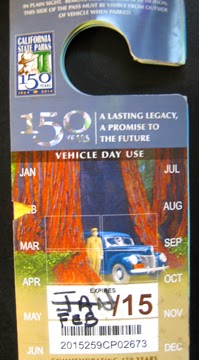
New pass — cheaper than last year's! — amid the detritus
of an inveterate doodler.
Another year!

One year more, for swimming my beloved Lake Natoma whenever I feel like (within reason and daylight … ), whenever I can, any day of the year.

Christmas! New Years! Sadie Hawkins Day! That's right, I said Sadie Hawkins Day!! Damn the limits!

Well, except March 31, 2016, when this contract expires.

But that's not gonna happen. I'll be in line that day buying the 2017 pass, probably after a swim. Bet on it!

Not that there is ever any line to buy the pass. I'm just melodramatizing my zeal.

This pass is so much more than a convenience and amazing bargain. It's a symbol, a trophy I award myself.

It means I plan to embrace the water at Natoma for as long as I can, one year at a time. This marks the beginning of my fifth year.

Since buying last year's pass, I have migrated farther up the lake to its northernmost point, where the water is coldest, and have nearly tripled the difference of an average daily swim. During the year our swim buddy ranks have thinned, from as many as five in spring, to one other swim buddy now. Life happens when you're making other plans, right?

Seems silly to design group t-shirts now.

I have swum the lake's length 10 times at least, and swum a double length once.

The pass marks my passion to do more — more lengths as a matter of course, a few more double lengths. Maybe permission to dream of officially epic swims, and let my body and mind toughen over time for that possibility, in the cold green water of the lake.

Distances and dreams aren't as important as to me as perseverance, and the realization I have swum at least five days a week for seven straight years, the first three in a pool at 4:30 a.m.

It's something grand for me that I'm glad to do, and hope fervently to keep doing.

I bought this year's pass at the ranger kiosk at the lower lake, Nimbus Flat. I usually buy it at the labyrinthine central offices of the California Department of Parks and Recreation in downtown Sacramento. I always forget in which of the nondescript towers the little windowless park pass office is, and I have to sign in at the front desk, and wear a little badge. So much Big Brother bother.

By buying it instead from the parks attendant at the kiosk, out in the fresh open air, I came away with additional swag I wouldn't have gotten otherwise.

I got:
Last year's pass became quite
the conversation piece:
"Hey," says the state park attendant,
"Why is 'January' crossed out and
replaced with 'February?'"
"The guy at the parks office made
a mistake," I explain.
"Why didn't he just issue a new pass?"
"Hey, what am I, Scotland Yard?
How would I know?"
No, I didn't say that. I say,
"I don't know."
(Pause for scrutiny.)
"Well, all right, then."
(Attendant waves me through.)
Repeat nine or 10 times.

  • A receipt! 
  • A recap of state parks rules. Nothing prohibits swimming, I see, though I'm forbidden to destroy or disturb natural resources. Destroy? No. But I couldn't say whether natural resources find me disturbing.
  • A pamphlet on how to reserve campsites in the California parks system. It's eight pages of very tiny type to explain this succinct concept: Good luck and God be with you. The state could write that on a Post-it®™ note.
  • A list of all the places we can and cannot go (mostly Southern California beaches) with the pass. 
  • A map of the state parks system, to go with the many other maps we already have. It feels weird that it's a 2013 map, but why spend my tax money if you don't need to?
  • A Guide to Eating Fish Caught in Folsom Lake and Lake Natoma. Trout 16 inches or shorter, as well as bluegill and green sunfish, are low in mercury. If you're not a woman 18-45, a woman who is pregnant or breastfeeding, or a child 1 to 17 years old, eat two servings per week if you want. Try the trout, the pamphlet says: it's high in Omega-3s!

    But don't eat any kind of bass, chinook salmon, catfish or trout longer than 16 inches. They're high in mercury. That goes for everybody.

    These things I did not know. Also, there are no known fish that have just medium levels of mercury. I don't know why. The pamphlet doesn't explain.
  • A pamphlet for Folsom Lake State Recreation Area. It's embarrassingly pro-Folsom Lake. Lake Natoma is the poor distant cousin, seen on the map but not heard from very much. Oh well, more for us swimmers.
  • A pamphlet for pumping wastewater from your boat, and how to prevent water pollution.
The receipt reveals a markdown in price. Last year's pass was $150, to commemorate the 150th anniversary o the parks system. It seems strange and ballsy to charge more money for such a commemoration, but I'm not in marketing.

I also got a wallet card that would have gotten me into All the Places No One Wants to Visit. It was free. I tried going to one of those places. It was closed. On a Sunday. Sunday feels like the kind of day one of these places would be open so folks could visit. You know, to give it a fighting chance. But I'm not in charge.

At either price, the pass is a bargain. If more people bought them, California's parks wouldn't be in such woeful shape, where gleaming water fountains stand broken and a bare water pipe sticks up out of the ground nearby instead, with a Cold War-era bubbler screwed to the top.

If you go to a California park or historic site even once a week, you should buy one and save yourself serious money. Do it for my sake.

I'm going swimming.

Thursday, October 2, 2014

Stigmata


Swimming has marked me for life.

Maybe that should be with life.

No, it has not shaped me like a carrot, wide at the shoulders and narrow at the waist like Ryan Lochte or Sun Yang, which would be nice. But it has deferred my becoming more bulbous, and that's nice too.

Less nice is the spot on my chest, the size of a quarter.

It is at once a modest red badge of courage and an editor's pen mark, a scarlet punctuation of my errors.

As our little group of swimmers has increased distances, each swim of course has required more strokes, which has brought together the bristles of my weird beard thing against the skin of my chest just below my right clavicle many, many more times. That moment comes as I bring my arm forward in a stroke and turn my face down again in the water after a breath.

I have been rubbing that spot raw since mid-June. Two weeks ago I emerged from a three-mile swim and the spot seeped blood down my belly. For long swims now, I dab the spot with Vaseline®™ — though sometimes I'm already 200 yards out in the water before I remember.

The beard is not to blame, though it'll wind up the scapegoatee. Really more of a horseshoe mustache, it's no more than a costume accessory for my other life as a 19th Century Irish bloke for the Sacramento Underground tours. It's merely more presentable, I decided, than the muttonchops I sported for the same purpose.

Without the mustache, though, few would know how really wrong I swim.

Even stranger than my infrequent but violent kicks, I breathe from only one side, every other stroke. For many perfectly sensible reasons, it's better for swimmers to breathe from both sides; typically swimmers take a breath from one side, stroke thrice and breathe from the other side.

It provides more balance, since freestyle is a symmetrical maneuver. Swimmers can better see their surroundings. I think such swimmers also have better lung capacity.

After months of practice in the pool, I got good at bilateral breathing. All it took was that first moment in the open water four years ago to abandon the technique. The water was too cold to keep my face in for more than a few seconds, and I reverted to the maligned breathing pattern I still use.

Though I try to keep my head and body aligned as I turn both during the swim stroke, I must be turning my head more as I face down, bring my chin into my chest at that red spot.

At least I'm consistent in my incorrectness.

My dentist during the last checkup noticed an odd shape to my jaw, an assymetry. He moved my jaw from side to side more than usual while he poked and "hmmm"ed and paused. If he had asked I would have mentioned my swim breathing. It causes me to slide my jaw left like I'm doing a Sammy Davis Jr. impression, to make as small a pocket of air as I can and keep most of my head aligned with my body.

But my dentist didn't ask. I think this breathing folly is reshaping my jaw, one more reason to work on bilateral breathing.

Besides, swim buddy Sarah has pointed out all the swooping great blue herons I have missed by looking left all the time. And it's true I missed most of San Francisco on my swim from the Golden Gate Bridge to the Bay Bridge because of the inland route.

In fear of oncoming rowing shells, I have adapted to scan the horizon between strokes. And I manage to breathe fine this way even in heavy waves, which is another good reason to be able to breathe from both sides. I miss the occasional heron, though, it's true.

I have tried to relearn bilateral breathing since, and risen from the water with face and head throbbing from the unusual motion. A moment comes in every swim when I urge myself to try again.

I will, maybe soon. Take a couple of aspirin and confine myself to a cove and just practice and practice, and come back a few more times.

Or maybe just shave the mustache.

• • •
In other news:

Tuesday, September 9, 2014

Yet so far away

Yesterday — somehow, some way — I swam two lengths of my beloved Lake Natoma.

It is one giant leap for me, one small splash for swimmingkind.

And all so ludicrous not too long ago.

Not too long ago — really, just three months back — I would amaze myself with the occasional 2.4-mile swim to a little island called Texas Hill near the middle of the lake. A mammoth swim.

Each time, I would crawl out of the water like I was reenacting the evolution of land animals.

Once a year, on Independence Day, I'd swim the length of the lake, impossible without a support boat and three stops to eat and drink. I was jelly at the end.

Now, every seven to 10 days a small group of us, sometimes just two, swim the length of the lake, a bit more than 4 1/2 miles. No support boat, no fuel except what we ingest before jumping in.

Swim buddy Sarah, gifted with the superpower of suggestion, compelled David — our other conspirator — and me to swim longer more regularly. It was the right time; we had exhausted the shoulda couldas, worn ourselves out with a couple of years of talking about it. Time to act.

Now two miles seems short, and we curse our conflicting schedules for it.

Sarah's been bugging us for a while to swim two lengths. We joked and made up names for the out-of-reach route instead, as we had begun to name our other routes.

A month back, to prime the pump for the double, we swam the traditional length — boat dock at lower Natoma to dock at upper Natoma — then added a round trip up the narrow rocky canyon to the boundary of Folsom Prison, for a total distance of 7 1/2 miles.

Common sense follows that we'd build up stamina for the double. A couple of more times of the length plus the prison boundary, for example. Then downstream and back up to Willow Creek, an additional two miles or so, with a lot where we could park and drive back to the starting point; swim that a couple of times. Then the length and up to Texas Hill and back to Willow Creek once or twice.

But we lack common sense.

With half a day off, Sarah and I made plans for Monday's swim. Sarah stashed food under a bench at lower Natoma; I kept mine in the tow float "butt buoy" I tether to myself. We parked our cars at the upper end.

Should we keep one car at the lower lake, just in case? Sarah asked.

No, we decided. We were like Cortés, burning his ships on reaching the New World. Conquer or die.

Or we could get out and walk back along the paved trail, if we really needed.

Hopes nosing out doubts, we plied the route, knowing from previous swims where the reeds and plants had overgrown in the shallow water, ready to trap us if we weren't paying attention. We knew where to look for any rowers; we knew one side of Texas Hill is better than the other for smooth unfettered passage.

We knew the chop was just a bunch of bumpy water. Adjust, roll a little more to breathe, deal with it. We knew the distant landmarks would remain distant for longer than we wished, and to be patient. We kept each other in sight.

At the lower dock we stopped and got out, violating international swimming rules, ate our stash and wondered aloud about walking back. In our hearts, though, we knew we could finish this, even if our shoulders and backs balked. A long moment of stretching and back in we went.

The water felt silky, aches went away, replaced by new aches elsewhere. Upstream was our usual route, and we knew it well, knew not to get too excited at every turn.

Along the way I thought, "This is really something!"

Followed by a new thought: It's really nothing.

It's all relative, of course. On my favorite facebook®™ page, Did You Swim Today?, swimmers around the world celebrate someone's first mile, or first open water swim, or first swim ever.

We also celebrate the gargantuan swims, the famous channel crossings, this time of year happening with stunning frequency. At times last week, it seemed a caravan of swimmers was crossing the English Channel, one right after the other, in the water at the same time along the tide-driven reverse "S" route from England to France.

Our long Natoma swim wasn't even as long as the six-hour qualifying swims English Channel swimmers must endure.

Within the last week, several teams and soloists have crossed the English Channel, including the oldest ever — 73-year-old heart surgeon Otto Thaning of South Africa — and the youngest to have completed what's called the Triple Crown. In addition to the English Channel, 16-year-old Charlotte Samuels of New Jersey has also swum around Manhattan Island and the Catalina Channel off California.

A 70-year-old Australian, Cyril Baldock, swam the Channel last month, holding the title of oldest crosser for only a couple of weeks.

In July, a Massachusetts woman, Elaine Howley, became the first to swim the 34-mile length of Lake Pend Oreille in Idaho. A northern California woman, Patti Bauernfeind, last month became only the second to swim the 25 miles across Monterey Bay, followed shortly after by Kimberly Rutherford (see a great video of her Lake Tahoe ice mile with long-distance swimmer Scott Tapley).

In Southern California last week, Peter Hayden became the first swimmer to circumnavigate Anacapa Island in the Channel Islands chain. (Channel swimmer Lynn Kubasek takes you on the journey with her video documentation.) Hayden topped it off by swimming 12 miles into the mainland. Shortly after, Julian Rusinek also swam from Anacapa to the mainland, last year having been the first to swim from San Miguel to Santa Rosa islands.

(Editor's addendum for Sept. 10: Carol Schumacher Hayden swam from Anacapa to the mainland this day. She just happens to be married to Peter Hayden.)

A New Zealand woman named Kimberley Chambers, who lives and works in the Bay Area, last month became only the sixth swimmer to have completed the Ocean's Seven Challenge — The English Channel, Catalina Channel, Cook Strait of New Zealand, Molokai Channel in Hawaii, Tsugaru Channel in Japan, Strait of Gibraltar at the mouth of the Mediterranean Sea, and the North Channel between Ireland and Scotland.

Just two months after finishing the 12-mile Tsugaru Strait, Kimberley capped her challenge with the North Channel, swimming through clots of poisonous lion's mane jellyfish. The constant stinging and exhausting swim briefly hospitalized her.

Kimberley writes eloquently and personally about her swims; I'm one of many waiting anxiously for her North Channel swim account.

Read also Jason Betley's blog, accounting his English Channel swim to raise money for the hospital that treated his son's brain tumor.

facebook®™ has enabled me to correspond with many of these stars of long-distance swimming.

I'm leaving out so many swims, only because we have so many to keep track of, including valiant but aborted long-distance attempts.

My Natoma swim only deepens my appreciation of theirs, magnifying the greatness of their feats.

Yet …

Now I'm wondering, and asking. Now I'm dreaming. Now a fire has begun burning about what if? All the swims I've swum this point seemed unreachable until I slowly reached them, after all. What could I reach in time? How far can we swim regularly when winter drops the water temperature? What else is possible?

Maybe. Just maybe.

In other news:

Ray Rice won't be play football in two weeks after all.

He may never play again in the NFL, now that video has surfaced showing him knock his fiancée — now his wife — unconscious with a punch that sent her sprawling against the wall of a casino elevator, a punch that appears to have driven her headfirst into a metal railing. The second punch he landed in that elevator.

A video that supposedly no on knew about. The Baltimore Ravens, Rice's employer until yesterday, and the NFL: We're surprised as anyone by this video!

Yeah, right.

Confronted with — or exposed by? — undeniable and appalling proof, the Ravens cut the contract of their star running back. The NFL, rather than suspending Rice for two games, suspended him indefinitely and required any team considering putting Rice on their roster to check with the NFL first.

Would any team consider it? I'm not surprised by much anymore.

The NFL looks extremely pathetic on this, with dim hope of being better without real reform and major changes in the league and the legal system that allowed this crime to go so lightly punished, until the truth emerged.

Rice's wife has criticized the NFL and the news media for her husband's consequences.

Is money the only thing that matters anymore?

Tuesday, August 26, 2014

Tainted love


An unfunny thing happened on the way to my favorite part of facebook™®:

Up popped a picture of a woman performing fellatio on a man. Various nude bodies took various positions in the background.

Porn has pocked "Did You Swim Today?" which has been just about the only reason I use facebook®™©.

Porn's sudden presence where no one expected it — and I trust most don't want it — has sent ripples which may spell rifts. I'll watch and wait.

When I started on DYST?, as users often call it, there couldn't have been more than a couple of hundred users, but they came from far and away — many parts of the United States and the United Kingdom mostly, but elsewhere too.

They have all to this point fulfilled a simple mission, as espoused here on the page:
Here's a place for swimmers (NOT SPAMMERS) to report on their daily swims. Did you? Where? Was it in the open water or a pool? Was it hard? Did something cool happen? Who was with you? Did somebody tell a good joke? Do you have a good tip to share? Is there an event coming up? Did you rip a good time?
And that's what has happened. Simple sharing, simple support. From a first time across a 25-yard pool, to multiple times across the English Channel, swimmers on DYST? have described their swim and how they felt, and others have encouraged and advised. Swimmers ask many and varied questions, and other expert swimmers, having been there and done that, answer in kind.

Swimmers have been funny, have been vulnerable, have been sympathetic and even teary, but in almost all encounters I've encountered, the conversation has been resoundingly, unremittingly in favor of everyone else's shared passion, no matter where, no matter what.

I have met some of them, from in the state and around the globe, and celebrated those visits.

Some have promoted themselves, or causes, in various degrees and fashions and frequencies — more than, "Hey, look, I swam here!" — but I take it there's a tacit agreement that it's all good in the name of swimming. Pursue it or don't.

About the only time I've seen swimmers get worked up over topics, it's been about swim technique and training devices or nomenclature; some argued a year back, for example, about "wild swimming" as a term some British habitues use for open water swimming, as perhaps implying vulgarity or lack of discipline. Everyone has an opinion on these kinds of things. But it's never gotten snarky or dismissive.

I'd bet the house that "(NOT SPAMMERS)" was not part of the original credo. It's a late addition.

I wasn't paying attention until complaints arose about the porn spam that DYST? now has more than 11,000 members — exponential growth since I started contributing and sharing less than two years ago.

As it's grown, I guess, DYST? attracted spam. Occasionally some person or entity will try to sell sunglasses, sometimes sofas (?). Some swimmers will try to cheekily shame them into going away, and I sometimes join in. Eventually the spammers will go away, though I doubt the shaming caused it.

Now the porn. I saw the complaints first and not the actual porn, so I wondered at first whether DYST? users might just be extremely sensitive. I mean, these people pictured in their swimsuits look pretty darn good.

Then I saw it: Yep, porn, standard explicit variety. No swimsuits.

Some have complained about it on DYST? Others say they still have not seen it. Some of those who have are threatening to leave the page, or have bid their adieu, prompting responses.

Here's where the whole concept of social media gets weird for me.

Some of the responses, in the spirit of DYST? have expressed sympathy for the feelings of the person leaving, and wishes that the person would reconsider.

In our fear of the unknown, some have said even hovering a cursor over the porn will invite a virus on your computer, or open access to private data, or stash porn secretly on your computer as a kind of rogue server.

Others, breaking wide of the DYST? ethos, have said in essence, "Good riddance!" or "Lighten up! It's just porn," or, "That's reality. Live with it."

All of which have spawned their own responses, and the discussion has acquired an acid tinge. Meanwhile, the guy who created the page, and someone on DYST? who seems to be in a position to know, said they're making efforts to get rid of the porn, which may or may not have been put their by people or entities that had gained access to the page.

The DYST? creator recommended maybe not using the page for a couple of weeks while spammer control ensues.

Which I'll probably do, being just about the last person who has any idea how facebook®™© works, nevermind how to root out spammers among more than 11,000 users.

Forgive me for sounding like the late Sen. Ted "The Internet is a Series of Tubes" Stevens when I say that facebook®©™ has seemed to me like a boundless cocktail party, only with generously distributed time-space portals. Except each is by him or herself in front of a screen, really, and any cocktails are B.Y.O.

One schmoozes at this or that klatsch, and one says something and others chime in, "I like that!" or comment as if in conversation. Someone shows you a plate of chicken vindaloo she's eating, or pictures of the vacation they're somehow concurrently enjoying, or produces a baby in a cute new outfit, or another handy offspring with a medal around his neck, and seeks your review and approval. And you give it or don't, and since you're really in a room alone in front of a screen, it's hard for the approval seeker, likewise alone, to infer by your lack of "like" whether you like the food or baby or medal.

Ads run in constant display about the perimeter of the cocktail party, along with alerts about what others in a vast corner of the party are doing. A nearby portal whisks you there to like and comment, or look and do nothing.

Now that I know that more than 11,000 people are on DYST? —and I know I haven't encountered more than, say, 200 different people in all the time I've been on DYST? — I wonder where all the rest are.

So now I imagine a boundless cocktail party divided into limitless banquet halls, each connected by open doors. I'm in the hall with the subset of 200 I see most every day, and the rest are in other halls somewhere, sharing and conversing with each other. The chance exists that I may see and encounter some of those in other rooms, but I think it's slim.

Someone, somewhere, brought porn to share or infect or anger or disgust or delight or whatever. The stash hasn't made it to all the rooms; the battle is met, apparently, to keep it from doing so.

I'm hoping the DYST? defenders win. It's another pressing issue over which I feel helpless. DYST? is important for me, even though it's difficult each day even to visit the posts of the seven dozen or so DYST? members whose exploits I see regularly.

I like to go to the Irish Sea with them, or the storybook stream beneath the stone bridge near the Lake District of England, or Lake Geneva or Lake Michigan, or myriad points along the California coast or the ascendant St. Johns River or the glacial depths of Argentina. I like the painless close encounter of jellyfish or moray eels, the vicarious wonder of dolphins arcing.

I'd be heartbroken to lose it.

• • •

In other news: I'm keeping it.


Or keeping losing it. Thanks to old friend Robert Zint who hollered all the way from Texas, "Use an electric shaver, you barnacle-domed dolt!"

He didn't say it really. He merely and in the most friendly way suggested the shaver, which is so much better than scraping with a razor over the bumps. I'm just trying to sustain the melodrama.

• • •

In still other news:

Friday, June 27, 2014

Flow and ebb

So now Doug's gone. Maybe just for a year. Coming back briefly in the fall. We'll see.

Lake Natoma got emptier.

We'd been swimming together several times a week for 2 1/2 years. Doug's leaving for his native New England to help with his grandchildren.

"Fast" Karl left earlier this month. Though he had only been swimming with us for seven months, he was dedicated, and his dedication inspired even if his speed deflated.

On his last swam before heading for work somewhere in the Rockies, he laced twice the length of Lake Natoma, about 10 miles. Notre Dame swimmer; whatcha gonna do?

Karl's a mountain man who found California's ways strange. I don't think he's coming back. Except, of course, to swim the length of Tahoe, 21 miles, later this summer.

What did good ol' Heraclitus say? "You could not step twice in the same river."

To which I add, "Not even with the same toes."

Change: The only constant.

Toes come and toes go.

Sarah had already joined our core group of rogues before Doug and Karl took flight. It wasn't until she said it out loud that we finally acted on our shoulda-coulda-wouldas, swimming longer distances regularly. Once a week for the last month, Sarah has swum the length of the lake, and small various and sundry of us have joined in.

The length used to be a daunting once-a-year enterprise, borne out on the Fourth of July. Now it's oh-so-slowly becoming a routine change in routine.

David's the iron man now, literally and figuratively. We've been swimming together longer than I have with Doug; in fact, I think it was a winter morning on upper Natoma when Doug first joined David and me.

David is the exception to every rule: An Iron Man©® triathlete who eschews triathleticism … a wetsuit wearer who defies conventional wisdom and swims just about as fast without one, when we can get him to … the polite smiling contrarian who I guess really meant it when he said he wouldn't pay the measly $10 annual fee to our meetup.com group.

That's how we all met, though, through the Sacramento Swimming Enthusiasts page on the meetup.com site.

But we've become an ad hoc splinter cell, using text messages to gather, rather than the site. We're the few who like upper Natoma chiefly, where the water spilling directly from the bottom of Folsom Lake is always a little colder. It's much less crowded, free of beachgoers. Few rowing crews make it all the way up here, most staying on the 2,000-meter race course at the lower lake.

We're the few who swim Natoma year-round. Most swimmers on the meetup.com site prefer the lower lake during the evenings (too warm, too crowded) or what's left of dwindling Folsom Lake, where gather the three forks of the American River that release into Natoma.

I've met so many meetup people on my scheduled swims, whom I see once or twice more and then never again. They either decide against open water swimming, or figure out the group's not competitive and I certainly am not going to give them much of a race, or join the Folsom/lower Natoma/evening swim crowd.

It got me thinking of those who stuck out the cold water with me in the four years I've swum Natoma:
  • Jim, whom I met at one of my first meetup.com swims, a Polar Bear event in mid-February. I forgot my goggles, my wife urged me to ask Jim for an extra pair, and we struck up an immediate friendship. Jim's the one who showed me not to take the open water so seriously, to revel in the realization that few people enjoy this or want to.

    When I first hit the winter choppy water of Folsom Lake I wanted to quit for good, and Jim's the one who told me to swim 10 stroke at a time, get my bearings, swim 10 more, and keep going — to let time get me used to the new adventure. I think of his help every time I swim through heavy water with confidence and a semblance of ease.

    We swam together most of two years, and many times he brought fast Kathy, a champion open water swimmer, which was a commitment since they had to come from two counties over. I swam in several open-water races with them that first year.

    Jim got a different job and different obligations, and Kathy's life changed around. I haven't seen them in a long while, nor have I raced since then.
  • Brad, whom I still see, though he's more rogue than us, preferring mostly to swim on his own, and swim great distances. I first saw Brad at one of the Polar Bear swims four years ago. All of us huddled at the shore in our wetsuits, tentative penguins, when suddenly came Brad in just swim briefs and goggles, diving in and swimming away into the foggy chill while we stood and stared.

    Until that moment, I thought it may have been illegal to swim without a wetsuit. But I soon resolved to swim that way since I hated wearing my neoprene, and weaned myself out of it, shedding it for five, then 10, then 15 minutes in the cold water after each group swim.

    I still swim with Brad on occasion. It feels weird to drive home after my swim knowing he'll still be in for a couple of hours more. He's swum the length of Tahoe, and a mile in freezing water; whatcha gonna do?
  • Stacy and I were the first long-term rogues, swimming off the meetup.com grid and venturing northeast to upper Natoma. It was exotic water when we first tried it out. Few boats and of course no swimmers, the only noise coming from the aggressive domestic geese that had been released to the wild to cadge visitors for food.

    Every swim was discovery and serendipity as we learned where the water was deep and where shallow. We learned to endure the cold water for longer and longer distances, and swim against current. We established routes under the new bridge, and downstream to Texas Hill, a little island where once Texas miners had come to dry-dig for gold.

    We swam many times when Stacy wasn't running or doing cross-fit workouts. We even swam the length of the lake one Fourth of July, me with my inflatable butt buoy and him with a modified boogie board he called his party boat, sailing behind him. It had a flag and a foam noodle arch and a stretch net to hold his food to the board. Even with a long fin below, the party boat capsized in the wind.

    Stacy once left for Tennessee to run a 30-mile race with his sister, and never really came back to swimming.
  • Ryan made the fastest ever transition from heavily wetsuited swimmer to skin swimmer — 10 minutes. He's a concert organist from Canada who showed up one day in a thick wetsuit with some sort of shirt over it, gloves, booties and what looked like deep-sea diver's cowl.

    You don't need all of that, we said. Or, really, any of it.

    OK, said Ryan and in one swim he became a skin swimmer. He was just about the most joyful open water enthusiast, but he disappeared after a couple of months.
  • Susie, her hair and smile dazzlingly white, also loved to whoop and holler and express on our behalf of the wonder of open water swimming. I think she sticks to the evenings and lower Natoma swims these days.
  • Helen, whom I met in the early days. I don't think she swims much anymore, but she probably doesn't have time, seeing how she now runs races of 50 and 100 miles regularly.
  • Myron, who was running the meetup.com group and cheerfully organizing Polar Bear swims and other activities, but who moved on to other things.
  • Patti, who runs the group now and puts a lot of energy into keeping the group going.
  • Special guest stars: Dave came all the way from Cork, Ireland, to swim in Upper Natoma last summer. Suzie, an ultra-marathon swimmer who launched the 24-hour relay swim in San Francisco Bay, last summer brought another marathon swimmer, Roxie, to explore upper Natoma. They laughed as they swim in too-shallow water past the first bridge and had to stand up on the slippery rocks.

    Lisa made a great arc through the northwest last week and stopped by my lake on her way home to the Bay Area. Lisa and David and Karl and I swam as part of team at Suzie's 24-hour relay swim in February.

    Nejib came from Tunisia swam lower Natoma last year, cold but not cold enough swim for peace in the Bering Strait. It didn't matter: He swim four kilometers in 39-degree water along the International Date Line. for his eventual 4-kilometer swim in the frigid water of the Bering Strait, a swim for peace.
  • Kate, completing her residency at a nearby hospital, swam almost every day with us for five weeks. We'd met at the 24-hour relay swim. She pushed our distance a bit to get her ready for a swim across Tahoe later this summer.

    Late in our swims, she said she didn't like swimming under the bridges. Lisa said she didn't like the shadow the bridge cast through the green water.

    We've come to know the scary plants are just plants, the shallows just riprap, the current just something to relax in and pierce through for half again as many strokes, the chop just a fun reminder of being present in the water.
  • I'm forgetting or misplacing some names, I know. The various Dans, Steve, Sean, all fast. Haven't seen them in a long time.
We've come to a happy peace about our relative speeds. If anything, I give the other swimmers a harder time for being fast than they do for my sloth. We collect at the shore, no matter our arrival times, and leave to drink coffee at the "adjective" Starbucks™® (so named because we sit outside next to the drive-thru and count how many descriptors drivers use to order their drinks), or good beer, or the occasional meal. Usually a going-away meal.

The only thing I could beat Doug at is cold-water endurance. Fortified with bioprene, I'd keep going while he'd turn back, and if we'd planned it right I'd leave my Thermos® of boiling water in his car so he could fight the intense shivers with a cup of cocoa. After winter swims it takes us a good 40 minutes of jumping up and down in the parking lot and sloshing hot cocoa all over ourselves before we're even ready to drive for hot coffee.

These days, though, with even the coldest water hanging in the low 60s Fahrenheit, Doug would swim well past our turnaround point and double back to meet me when I hit that point. The Thermos™ of hot water is more reflex these days; I pack it but we don't use it.

A go-getter whose actions speak louder than words, Doug has already created a meetup group in his homeland, New England Open Water, and has a swim already planned next weekend in Thoreau's Walden Pond. Twenty "BigWataSwimmas" have already joined.

The core group at upper Natoma has changed and shifted. Though I've been lucky of late to swim with someone else, I'll probably end up swimming by myself again many times. I know I'll swim many, many times with David and Sarah and Patti, and that a new swimmer or two will show and join our group. Most will leave after awhile. A precious few nuts will stick around for long run, and we'll keep on swimming, finding new routes, new swim adventures, different lives to talk about over coffee or beers.

That's the way it's been, the way it will be.