
 |
| Just a teaser … almost everything in this image changes |
 It's the world of, well, maybe not tomorrow, but noon the day after.
The client, in the business of securing a steady supply of electrical power for California — at the best price — is therefore in the business of promoting the most efficient electrical production and use, so that the supply and price remain sane and attainable.
Assignment: Depict this efficient California-ish world in operation, and capture its best side. It's a world that harnesses wind and solar power, and stores energy produced at lag times so that it's available at peak times.
It's a world of micro-grids — places like universities and hospitals that can produce their own electrical power in case the larger grid goes down, and can sell excess power to the larger grid when everything's working.
 It's a world pocked with smart devices, enabling consumers to control their energy-efficient homes remotely.
And it's green, in several ways.
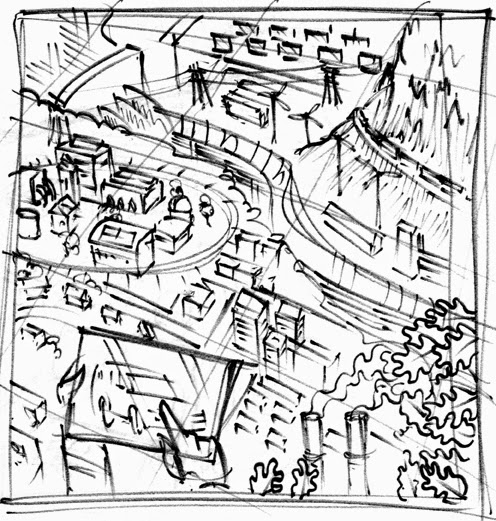
The drawing went through several iterations. Sketch first: How to get this all in one squareish illustration? I pictured a kind of model railroad city at first: Harnessed river running through the middle and guiding the eye across … a mountain slope above with a train coming around the bend (natch!) which reminded me a little of the Donner Lake section of the Sierra Nevada.
The city lay in direct danger of a failing dam, but I sort of hoped viewers wouldn't notice. Buildings crept up an unseen slope in the foreground.

What city would serve as a model for it?
My first thought was Portland, Oregon, built on the hills on either side of the Willamette River. Though not well traveled, I think I'd have a hard time finding a city that affords such sweep upon approach. The whole of Portland seems to lay open all at once as you drive into it.
The Santa Barbara Channel and its distant islands stood in for the background, and despite the high rises, the town itself resembled my hometown, filling a long valley. It even has terraces like my hometown, though oriented differently than this one, from which you can look upon the whole valley.

The refined sketch looked like this:
The spaces became more defined. "Regionalism" in the upper corner, refers to a suburb or hamlet that might require different power needs than the larger region. "EV" is electro-voltaic, electric cars and a mega-charger.
The lines represent where type would go, and they played a big part in the constant change of the art on the way to final.
Here is the assignment as it progressed through color:

"Regionalism" went right out the window. The little suburb in the left hills disappeared, replaced by a map of western North America power production and distribution. Watch that space: It changes a lot. The disembodied hand at the left is a consumer; the one to the right is meant to represent the client/agency.

The map expands, buildings narrow in color palette. The client/agency hand loses nail color, and the red car goes blue. The center objects get pushed to the side or eliminated to make room for type. Mountains slide in, blocking the path to the sea.

The landscape fills …

… and thins again, as the foreground car disappears to reveal a house on the hill, full of smart devices on the house and a charger for the car. The homeowner becomes the disembodied hand on the right with a smart phone instead. The client/agency becomes the hands on the lower left. The landscape gets greener, the microgrid/college campus gets rearranged, and that darn map keeps changing color.

While the middle ground gains ground and loses buildings once again, so does the map changes color, in an attempt to show it as a separate icon but at once blend into the background. Agency/hand gets a bank of computer screens, and homeowner makes clearer why he/she has a smart phone and knows what to do with it. I built the illustration in layers for this purpose, being able to lock everything but the particular slice of heaven I had to modify.
This is close to final. The buildings on the right, with their Formica®™ table-top roofs, disappeared or became much simpler in the art that went to print.
It's fun to see my work so large, which doesn't happen often.
•••
Speaking of Tomorrowland®™, a good way to enjoy Disneyland®©™ without the trouble of going, is by watching Randomland®© on Youtube. A quirky, energetic guy named Justin Scarred visits for you — every week! —and posts frequent videos of the quirks and mysteries of the theme park, which he clearly loves, and about a lot of Southern Californiana such as Knotts Berry Farm. Check it out.
•••
•••
Hallow hollowed anesthetized: Though I meant what I said last post about thanking the people in my life who served in the military, I see the point brought by swimmer and veteran Nick Alaga, founder of the fundraising charity Will Swim for Food, about how thanking a veteran is not the most appropriate gesture.
He points to a website called Revoltdaily.org in which a writer, Ky Hunter, cautions:
The obligated sentiments of thanks, the forced imagery of heroics, the patriotic necessity of venerating those who wear the uniform have all contributed to the fact that veterans are seen as some one-dimensional homogenous entity. The simplicity and sterility of "thank you for your service" allows veterans to remain faceless and sterile. And for the public to keep us at arm's length from what really matters. It allows the civilian world ro go back to their daily lives feeling like good Americans because they thanked a veteran today, without taking any ownership of their sentiments.By "ownership," Hunter recommends thanking veterans for opportunities we enjoyed back home because of their service, which cause them to miss the same opportunities — attending the birth of your children, going to all their games and matches, luxuriating in quiet weekends, being able to live where we choose.
Sure, I feel guilty. I didn't serve, chose not to, felt horror at the events of 9/11, but not a compulsion to enlist, believing the ensuing wars a mistake. Others joined regardless. I feel weird thanking veterans because I have removed myself from their journey and have no connection except as a citizen, and I feel powerless to know how to do more.
Camillo Bica says don't feel powerless, because we can do more; don't just thank veterans for their service. A former Marine Corps officer and Vietnam veteran, now a professor at the School of Visual Arts in New York City, Bica writes on the progressive Website truth-out.org that people can do much more than thank veterans: Make demands.
Demand, for example, an immediate end to the corporate takeover of our "democracy" and to the undue influence of the military-industrial-Congressional complex. Demand sanity in Pentagon spending and a reallocation of finite resources to people-focused programs such as health care, education and jobs rather than to killing and destruction. Demand an immediate end to wars for corporate profit, greed, power and hegemony. Demand that we adhere to the Constitution and to international law. Demand accountability for those who make war easily and care more for wealth, profit and power than for national interest or for the welfare of their fellow human beings. And finally, demand the troops be brought home now, and that they be adequately treated and cared for when they return. So, should we meet on the street one day, do say Hello, or Fine day, and as you talk to me about your efforts to make this country and the world a better and more peaceful place in which to live, I would be happy to thank you for your service.
The obligated sentiments of thanks, the forced imagery of heroics, the patriotic necessity of venerating those who wear the uniform have all contributed to the fact that veterans are seen as some one-dimensional homogenous entity. The simplicity and sterility of “thank you for your service” allows veterans to remain faceless and sterile. And for the public to keep us at arms length from what really matters. It allows the civilian world to go back to their daily lives feeling like a good American because they thanked a veteran today, without taking any ownership of their sentiments. - See more at: http://revoltdaily.org/stop-thanking-veterans-for-their-service/#sthash.DTcVev19.dpufThe obligated sentiments of thanks, the forced imagery of heroics, the patriotic necessity of venerating those who wear the uniform have all contributed to the fact that veterans are seen as some one-dimensional homogenous entity. The simplicity and sterility of “thank you for your service” allows veterans to remain faceless and sterile. And for the public to keep us at arms length from what really matters. It allows the civilian world to go back to their daily lives feeling like a good American because they thanked a veteran today, without taking any ownership of their sentiments. - See more at: http://revoltdaily.org/stop-thanking-veterans-for-their-service/#sthash.C8Zbmu0n.dpuf


